One more historical evidence from Hindu prayers and Puja rituals. Most of us are familiar with the Sankalp(am) we have to perform before starting a Puja or Homam (a ritual with the holy fire) or before going for an Archana (customized service-like) for the Hindu deities wherein we have to mention the place (our location), time, names of the devotees with their birth stars as per Hindu calendar. Until today we mention the place as Jambudweep (the large continent which was once an island landmass), followed by Dakshina Parv (south face) (southern part of the Jambudweepa), Bharath Khand (Greater India), Bharatha Varsha (Indian subcontinent). (The pundit/purohit invokes the deities with details usually on our behalf. In home pujas we invoke the deities with the minute details by ourselves). (This means we are summoning the deities of Puja to that particular geographical spot personally. Our identity or address is the geotag with our name, birthstar, Kula/Gotra (family/clan/lineage) specifics. The Jambudweep is the landmass that was once surrounded by water. It can be now comprising the entire Eurasia. Dakshina Parv refers to the southernmost part of the continental shelf. Bharath Khande is the Greater Bharat or Akhaand Bharat comprising of present day India, Pakistan, Afghanistan and even parts of erstwhile Soviet Union such as Tashkent (Takshashila), parts of Azerbaijan etc. Hindu Dharma was prevalent in Baku of today. There are Sanskrit inscriptions preserved. The old Sankalp that we have not edit to current times must be from primordial times.This was a time when the tectonic plates had not yet had the head-on collision, exactly where there was once the Tethys sea which later on was replaced by the mighty Himalayas, the newest mountain range in the geography and history of Planet Earth. Interestingly all our prayers OMIT the Himalaya region but mention the Jambudweep as a separate island entity (Dweep in Sanskrit means ‘island.’ (We have until today the Lakshadweep (a lakh or million islands – an archipelago) which is a union territory of India (in the Arabian sea near the coast of Kerala)). The name for the country is Bharat, after Bharatha, who comes in the lineage of Lord Rama. For millions of years, India has thus gone by the name Bharath. Bharat is the original name of India, not Hindustan which was the name given by the Persians. India presently goes by Her name given by the Europeans. I for one thing never paid attention to these details even though we go through these motions in most of our rituals. We blindly recite the sankalp hardly paying any attention. For our weddings and other muhurats (auspicious timings for occasions like nuptials, pujas etc.,) we strictly follow the Hindu calendar in India. Our stock exchanges open and close annual accounts on the Hindu new year day which is the Amavashya (new moon day) of Diwali. In Tamil Nadu we adhere to the Tamil Hindu calendar. Our new year is just around the corner April 14th and this is the day Bangla, Punjabi, all of South, Behari, and even most of South East Asia including Bali/Indonesia, Thailand etc., celebrate their new year. The sankalp mention of Jambudweep, Dakshina Parva, Bharatha Khand/Bharat Varsha succinctly omitting Himalaya region is an indicator to the rituals observed in another plane of time, perhaps preceding even the times of Ramayana and Mahabharatha. River Saraswathi discovered deep down earth’s crust buried in a supposed catastrophe that changed our planet’s geography forever is another indication that there was a robust Hindu civilization far advanced in different dimensions preceding the current human evolution. It is possible that we merely picked up the pieces left over our ancestors to start again from the remnant of an old world. I have always felt this when reading the Sundara Khanda of Ramayana where there are details of the chariot of Ravana, the king of Sri Lanka that went by the name ‘Pushpaka vimana.’ Didn’t Ravana play Veena which is still the revered ancient/contemporary/native stringed musical instrument for Hindus. Then there are the surface to surface, surface to air, air to air missiles mentioned in the Mahabharat and even in Ramayan. These disjoint proofs pointing to another plane of time, another world are available in Hindu texts/scriptures that cannot be from the recent history of the human race. Unfortunately they cannot be cohesively or entirely interpreted without scientific backing. Interesting that I got to listen to this piece of information from a lecture on Soundarya Lahari, composed by BhagawadPada-Adi Shankara in the 7th century CE. Sadly as this is Hindu history, no research may follow or even encouraged, because the Abrahamics are always bent upon disproving anything with Hindu origins. Lately there is a changed mindset wanting to know what is what, with an element of curiosity about assembling the jigsaw puzzle for a better understanding about human ancestry and evolution. This is why we need to study our scriptures in depth: they throw valuable information in every single verse. Ancient Hindu scriptures are a repository of knowledge and info that can shed light into the mindset, prevailing culture and civilization of human race that is not recorded history. The galaxy did not come into existence from the birth of Christ. Most Hindu customs and even everyday rituals must be contemplated for their purpose and antiquity. Some excavations shall never be carried out. Some exhibits shall never be tabled. Some truths shall lay buried and never be discovered. Besides, you can never relate to the lost world with the threads of evidences you unearth here are there. The vital connection is severed by time and space.

 vijiravindran's
Such a wonderful writeup. Thanks for the informative post.
LikeLike
Thank you.
LikeLike
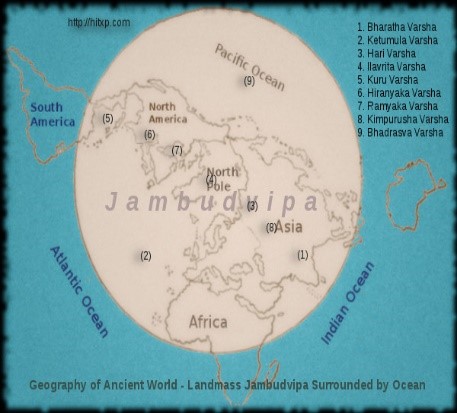
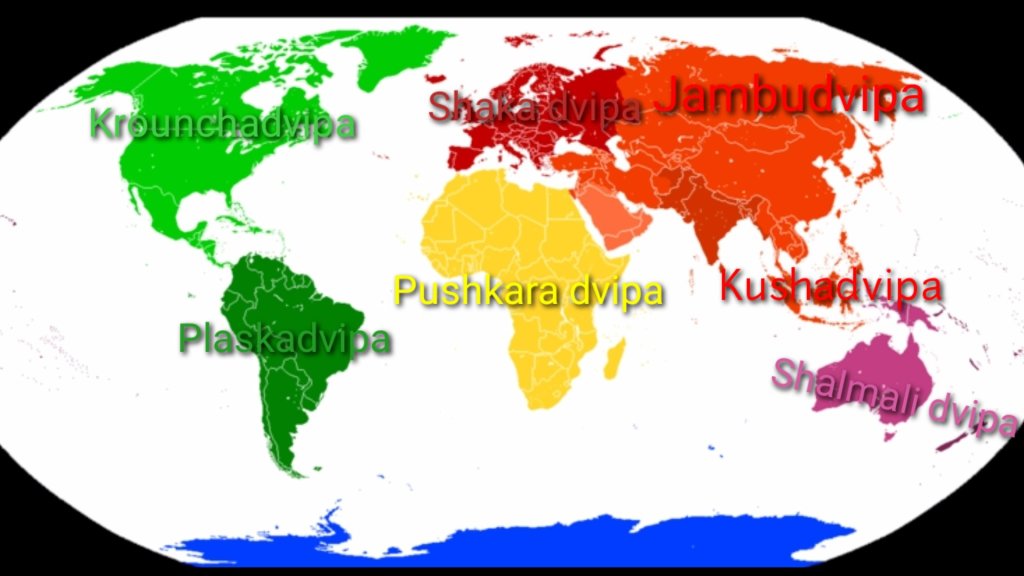
This is a nice write up on Jambudwipa. There are 2 maps you showed one showing the entire earth as Jambudwipa and the other map with all 7 dwipAs.
People in North America sometimes use “krauncha dwIpA” for sankalpam. I have always questioned that one because from the distances mentioned in scriptures, jambudwIpa itself goes deep in space. Krauncha dwIpA and other dwIpAs are part of brahmanda, but not close to us in anyway.
Hence, I think and strongly believe that the entire earth is in Jambu dwIpA. The term dakshine parshve is not to be read by itself. It is actually prefixed with the word “merOH”. Hence, “dakshine pArshve”, meaning south of Mount Meru.
Mount Meru is in North Pole and the entire earth is south of Mount Meru. However, the term meru is used locally to denote a hill or mountain that is the tall point. People interpret Mount Everest as Mount Meru, and because of that reason they surmise there are other dwipAs on earth. There is a meru in Indonesia as well. Since it is a commonly used term for high points, it does not refer to any local tall points, but the true Meru ONLY, whose base is in North Pole. The actual Mount Meru is supposed to extend far deep in space. Devas live in this region. This meru concept coincides with the 1-year of humans corresponding to one day of devAs. We have the dakshinAyana and UttarayAna periods for 6 months each. we have the Arctic region with long nights in winters and long days in summer.
This could be a very long discussion, but I was writing to ask where you found these 2 maps and any related notes that have on them. If you could post them, it would be very helpful to better my understanding.
Ravi
LikeLiked by 1 person
Thank you so much on Meru clarification. I am just a casual amateur blogger. I don’t know where I got the maps from but one of the lectures I listened to mentioned that no Himalaya is mentioned in ancient texts. I am no expert in any of this. Just wanted to share in this space.
LikeLike