
The best of hypocrisy.
I’ve never penned a review hot, hot. A first time for me. Forgive me for errors because I am not any authority in classical music or dance forms of INdia inspite of having touched the Veena for a few years of my early life (that I failed to capitalize on owing to family conditions). Anyway here it is:
Today is Aippasi Pournami and we have Annibhishegham in all Shiva temples across India. So I dashed to my street temple, had a peek at Him when the veil was lifted for a second by the archaka and made it in time to the musical dance drama in Naradagana Sabha this evening titled ‘Kamalakshi.’ But not before stopping at my tailor’s. Its rare for those like me to go straight to destination without getting fatigued running some errands on way to anywhere! So when I arrived, the hall was full already and I had to search for a seat. But I guess I probably missed only the opening scene – because time then was still only 6.35. Or may be I missed nothing and that was the opening.
Being a Mylaporean, I grew up watching live stage dramas in RR Sabha, Bharatiya Vidya Bhavan, Mylapore Fine Arts etc., as my parents were members of these sabhas. We attended year round most cultural events. Our house was also in proximity to Kapaleeshwara and Valleeshwara temples which meant we listened to free kutcheris (Karnatic concerts) round the year. Rarely had the treat of watching even those like Ilayaraja and K J Yesudas I think. So my affinity for stage dramas in Tamil is so much. My last live stage play was in Rani Seethai Hall, in Parrys corner, Chennai screened by Crazy Mohan (I think) (or SV Shekhar) and that was before I married! So imagine, watching a play after over 30 years! Live! Dance drama is something that my school specialized in. It was a permanent feature in our annual day and cultural day. So I am also kind of familiar with this art form of merging Bharatnatyam with Karnatic music. The pioneer award actually must go to my school as I have watched almost everything from Dasavatharam to Ramayana, Mahabharat, Nala-Damayanthi and other sub =stories etc., from younger years. In fact this is the main reason I wanted to watch the show today. It was like returning to my roots. So many memories flashed back from my teens in Mylapore.
Still I was not prepared for the quality entertainment that enriched my soul treating every sense of mine to finest art this evening. The music-dance drama exceeded my expectations. Kamalakshi is the best that could have happened to the evolving traditional art scene in Chennai in recent times. Even for laywoman like me, the kritis flowed like nectar to ears. I counted upto four: Thyagaraja yoga vaibhavam, Sri Kamalambike (Shree ragam), Teruvil varuvano , Hiranmayeem Lakshmim (raag: Lalitha). I am having problem recalling the one on Thyagesa, a rare one. Its ‘ruchelu?’ New to me. The Shringara rasam is always magnetic over the Bhakthi rasam is it not? The live renderings were awesome by Sikkil Gurucharan. I am listening to him in last one year only. This is why I would want to go for stage shows as well. They are way too different from recorded You tube uploads. You tube hardly does justice to a classical artiste. Unless Gurucharan’s kind of Bhakthi is there for Devi, art makes no sense to me. His bharatnatyam consort (!) I mean the dancing partner Sumitra Nithin was equally good but I must admit I am blank both on Carnatic and Bharatnatyam. Not exactly qualified to do this review but then this is my blog and its entirely upto me what to do and what not to do here! Standing ovation to entire cast who were so natural on stage. Every single character stood out in performance carving a niche for himself/herself. Neela’s rendering was equally great. I liked her slightly husky voice that sounded a bit like Harini. I prefer that kind of throaty voice to too very sweet tones like KS Chitra for instance. The dictionldialogue delivery of the play got me: crystal clear without a confusion. No mix-ups, picture perfect – which means terrific practice. I wouldn’t give any other reason for success. The length of the play was that of a celluloid flick: running just a little over 2 hours. Some editing can help.
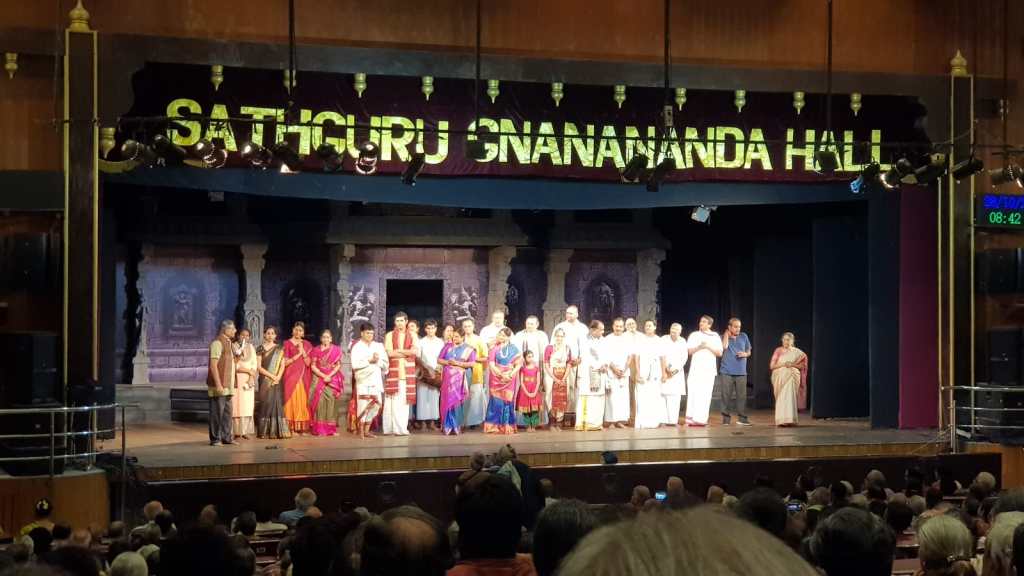
The plot was predictable and as such looked like a lift from Thillana Mohanambal or it could be the other way around: it is possible that the 60s classic cult Tamil picture was based on Kamalakshi (if the legend is true). The destiny of Devadasis! But in real life I knew a family. They were originally from Thirumullaivoyal. When the system was legally abolished during the time of independence, the daughter of the family who lived to a hundred years married a wealthy cardiac surgeon in those days. The late matron left behind dozens of beautiful daughters, granddaughters and great granddaughters highly accomplished and serving as doctors and software engineers in India, Malaysia, UK and the US. They are all classic beauties even today. You have to watch their body language. Strangely not a single male progeny for generations in that family! Nobody would believe their roots today but my family (parents and in-laws) alone is privy to their origins. Sincerely it is not a shame at all and I do regret that they have to still hide their origins. Whatever remains of them as of now as family in the city is stinking rich, but class. They maintain a low profile but their past history hardly matters in present day context. What now I am remember is that the grandma of the family got bunch of season tickets for December Music festival of Chennai for decades, driving from one sabha to another. It made sense to me only when I grew older.
Pat on the back to the Mirasudhar who captivated the audience with his stellar performance. Although the play was in English language, the accent was so Tamil that I believed it was Tamil almost! A word on settings and lightings: muted and subtle appealing to your finer senses, no wonder because PC Ramakrishnan was behind the scenes literally! Smooth transition of the stage scenes with no hick-ups. The Thiruvarur sannadhi set looked surreal – I mean too real! Took very little but added precious backdrop to the drama. Acoustics weren’t to be left behind. Good audio infused the much needed life to the programme. Just the right frequency so as not to screech at your ears or echo.
Of course, I hope to be in Thiruvarur before the end of this year. The cross-legged Kamalamba is my all time favourite. I do notice the Yogic poses of our deities. My Lalitha dangles Her left leg and has Her right folded. Mookambika and Kamakshi sit in lotus pose. Bhuvaneshwari has Her right leg dangling and left folded! Kamalamba is the only one with that curious Yogic posture of Hers. My other favourite is Badra Kali. I don’t curse but I tell my Kali always this: whoever harasses a woman, write down his Karma like he watched his mother changing! To that extent, I converse with my Devis/deities. I feel the goosebumps, vibes at opportune moments for decades now.
I wasted a ticket that I was to gift my friend who is into classical. Very recently she even flew to Trivandrum to watch a live concert in Navratri Mandapam. But she took ill so couldn’t attend. I wish she had because she is an exponent in Carnatic. And she is precisely someone who could have given the technical comment. I am just a connoisseur of good art – classical that is. I am sick of commercial cinema that is going third rate. Maintaining uncompromising standards is also important in a society but I do agree, masses need their share of entertainment too.
Delighted to find the auditorium packed. Still shocked to observe people packing bonda after bonda into their mouths when the screens were down and even when I entered the sabha! Had i had a friend, I would also have nibbled at a bonda over a cuppa! Missed my friend Sundu really.
I want to close the post sharing the strongest vibe that I felt in the climax. Only Shakta followers can get me. When Kamalakshi drops lifeless swirling to Sivaguru’s vocal in the sanctum of Thyagaraja (Shiva) in the Tiruvarur temple, involuntary tears welled up my eyes and rolled down my cheeks. I felt a strong vibe that I occasionally do in my pujas or temples or at other rare times. As I sense that the cast and production unit may be Shaktha followers or at least ardent followers of Shakthi, I am sharing this vibe of mine with you. I thought Kamalakshi was there this evening. For a moment I doubted if it was Thyegesa Himself. Because I got a doubt whether Kamalakshi was fictional character or real life character as this is a story penned by one Mrs. Sujatha Vijayaraghavan that could be based on inputs from hearsays. Is there a temple edict for evidence. I need clarification on this. I can tell this much to Sumitra and Sikkil Gurucharan: believe me I felt strongest vibe of whoever it is in that last scene. I found myself whispering quietly, ‘is it you Kamalakshi or is it Thyagesa. who among you is here this evening. My vibes tilted mostly towards Kamalakshi. Even as I type this, my face has lost its sense for 45 sec or so and i feel like my head is bobbing in space. I just got a confirmation right this moment. Someone WAS there! But who will believe me if I tell them this – other than my guru and fellow Shaktha maarga shishyas.
Karnatic music is divine. Bharatnatyam is divine. As an ardent devotee of Devi Shakthi I sense this every single day of my life as I listen to Navavarana kritis or any Devi krithi. We all must treat the traditional art forms of India with utmost reverence and desist from smudging the arts for personal gains. Of the Trimurthis of the Karnatic, I am partial to Muthuswami Dikshithar because he composed/ sang most of my favourite Devi kritis (in my limited knowledge that is) so when most go gaga over Thyagaraja, I have a soft spot for Dikshithar.
As the war between Israel and Palestine rages, google and check out the geographical extent of these warring countries. Miniscule. Tiny. That is however average size of many Arab states/Middle Eastern countries barring a few larger ones like Saudi for instance. The limited terrestrial spread makes security a major and constant headache for these already volatile nations. Most share borders with at least two or three neighbours making them vulnerable to coup attempts etc. Basically Arabs are nomadic tribes and terrain wars are in their blood. They are best left undisturbed. The warring factions maintain a precarious balance that the outsiders unwittingly can tilt making it worse for them. There is fragile peace in existence that must be maintained at all costs. The prosperity of the oil exporting nations does not automatically guarantee them the sense of security. Typical example is Kuwait which was invaded by Iraq under Saddam Hussain. The very limited geographic territory as well as native population make the Arab states sitting ducks to militant coups and conspiracies by local tribes. A sultan may marry many women and beget a dozen sons who will all be raised in secrecy, in fear of their safety. Among those who survive, someone can ascend the throne at a later date. More than anyone we Indians know how Islamic societies/reigns function. In Mughal dynasties, siblings killing siblings, fathers disposing of sons, sons assassinating or imprisoning fathers etc., is not unheard of. In fact this is documented history. Family is dispensable for them for the sake of the throne. The trust factor among the ruling elite family members is practically absent. Wives conspire against each other’s sons, even when they remain married to the same sultan. Have you read about the bed chambers of Arabs? The men sleep in separate bedrooms. The queens sleep in their own chambers. The king will choose to spend the evening with whichever queen but later return to sleep in his own quarters for the night. Couples don’t sleep together in arab culture.
In Arab culture and in general islamic culture, men eat out of the same platter whether it is bread basket or biriyani. I used to be impressed by this brotherhood but later I was told that, this practice is in place from historical times fearing poisoning by conspirers. Eating from the same plate ensured that your life remained safe. To that extent, you can see paranoia in Arab society in every aspect of life. Nothing is to be taken for granted. Any son or crown prince can be assassinated by a mercenary even in foreign soil such as America or England. So the Arab royalty takes nothing for granted. They live forever fearing for their lives, for the safety of their families and a military coup or uprising any moment and especially at unexpected times. Which is why security in these nations is very detailed. The arab countries never take chances. They have very strong setup of ultra sophisticated security of many tiers instituted by western thinktanks. This is very much understandable. From poisoning to hit-and-run, anything can happen to Arabs in power anytime. The western countries are also gawking at them waiting for an opportunity to start a war and decimate them in the garb of global security or fight against terror. All these probabilities are practically factored in by intelligent Arabs these days who hire expert tech advisers in these matters. Remember with their kind of oil money, they can command any service to work for them.
At times, having lived in this hotspot for years, I do feel a heaviness when I think about the temporary nature of their survival. It always used to strike me that, at best the Arab nations can only postpone their chaos. The threat of instability lurked in every corner. It never took much to overthrow any sultan in the gulf states as history has revealed. Arabs award death sentence for dope suspect/drug carriers/conspiracy suspects because this is vital for their survival.
I am a citizen of India where thousands of uniformed soldiers guard our national frontiers in the boundaries we share with China and Pakistan. India is also a peninsula surrounded three sides by ocean which makes us safer geographically, to a large degree. We are not a landlocked nation. Our population of 1.3 billion is our strength. India is also the seventh largest country in the world. We are sizeable geographically that no military coup can ever overthrow our government for the simple reason that we are too big to contain by limited power. Small countries like Singapore, Malaysia, Belgium etc., amazed me therefore. They gave me a sense of insecurity in that, I imagined them being easily accessible in event of a war and being dependent economically overwhelmingly on neighbours or third party countries. Singapore looked forward to Malaysia even for their water supply. India is a safe heaven.
Arab countries may have oil money but that did not prevent Kuwait getting invaded. Arabs therefore impose stringent laws for their self-protection. Most places in arab countries are restricted zones where photography may be prohibited. Violation of laws can get you prosecuted landing you behind bars. Arabs are also acutely aware of the hostility they face in the rest of the world. So their strict laws are better adhered to. Never take anything lightly in Arab soil. Remember in Islamic societies, if a woman files a case of rape in a legal court, it is she who will be awarded sentence and not the man! Under worst circumstances, she could be sentenced to death. She could count herself lucky should she manage to get away with cane flogging or stoning! So where laws are different or skewed, foreign nationalities have to be extremely careful not inviting problems. Foreign citizens and even foreign governments also must contemplate on the heightened sense of insecurity most Arab states live with. There is no guarantee that any crown prince will take over the reins of the sultanate from his father. There is no possibility for democracy because in essence, Arabs are tribal groups, divided into rival gangs. Getting them united under one banner is not easy. Sabotage or suspected espionage therefore becomes an unpardonable ‘war against state’ in arab dictionary. If you get this simple logic, you will understand the arab paranoia.
All these may make the expatriates living/working in middle eastern countries develop sympathy for the Arab rulers. Self defense is valid reason for nations beefing up security. In today’s world, war first assumes at the tech sector. The expats respect the state of mind of arab states and the laws and rules and regulations they have put in place for their own security. Cyber-vigil and always on their toes anticipating unforeseen trouble, the middle eastern countries always are on their edge. Until forty years back, most arabs were still bedouin communities who led a nomadic life wandering the Arabian deserts with camel herds, not restricted by geographical divisions. The concept of nationhood and parcelling of lands into different nations is a product of the second world war – even if by and large we had an idea. The arab countries also like most of the world were torn apart in conflicting ways. Israel-Palestine problem is an outcrop from this situation. While some parts of the world have since cooled off, Middle east continues to be a flashpoint in this respect. Americans can be the last group of the humankind to ever attempt to understand the complexities of Asia and in specific the Middle east. ARabian gulf is a hornet’s nest. Do not disturb unless and until you are confident you can fix everything gone wrong there (in your high opinion that is). Otherwise stay away.
It is important to respect the territorial sanctity of geographically small nations as well. Just because we live in a well appointed villa, we can have no ethical or moral right to park in front of our poor neighbour or trespass or try to outright buy the adjacent property or simply squat/take over their possession. Every square inch of their national territory must be protected from illegal encroachments. Big, powerful nations of the world must give a thought to that. In your capacity, help the small nations survive amidst animosity and insecurities they may face from conspiracy groups.
Two years back when my husband told me that his builder friend who was living in an apartment complex of six flats in Ashok Nagar had to vacate the premises because the whole building was infested with termites, I found it unbelievable even if it came from informed persons. All the families moved out as the entire edifice succumbed to relentless termite invasion as colonies of white ants took over wall to wall, ceiling to ceiling. Now the only hope lies in pulling down the hardly twenty year old structure and go in for reconstruction after due chemical termite treatment, completely eliminating the roots of the termites from the soil. The termite story sounded farfetched to my ears. It was bizarre, the kind of which we have not come across in the city. Termites do occur but go away on proper treatment. Afterall, India is a monsoon country. Chennai is wet for months every year although we don’t have intense rains every single day. But it keeps pouring every late evening during monsoons and the wall dampness is there for half an year. The moistness combined with our wooden furniture and fittings make for a fertile ground for termites to breed in uncontrolled.
I met with a friend who is a resident of Nungambakkam for last forty years. I was taken aback when she said, in all these years as resident of central Chennai, her residence was never so eaten by termites. She has lost her living showcase and wardrobes to the termites spreading like wildfire to the upper floors.
My friend in Saligramam said she has lost both her bathroom doors to termites.
My apartment block is under attack from termites for over two years now. A fairly recent construction a mere 12 years old, it took us by shocking surprise. We have since been treating the termite engaging pest control services in vain. Finally hopefully right this moment, we have the termites under control. In my home, the termites devoured an entire wardrobe in one of the bedrooms. My neighbours have lost doors, windows and wardrobes to termites. One has lost the entire carpentry from the wardrobes in all the three bedrooms along with the kitchen cabinets. This kind of massive termite invasion within a very short time, we are seeing for the first time in our lives.
I have seen termites in the second floor terrace bedroom of my old Mylapore house when I was a little girl. That was because we had rain water stagnation in the roof that seeped into the wooden rafters. Even then the termites could not eat the Burma teak wardrobes hand chiseled by a carpenter my grandfather had engaged for the work. The teak cot and the rosewood dresser too escaped the termite assault under the same roof. The teak cot was with me for years before I gave it up for a new one. The dresser I still have, over a hundred year old and going strong. It almost feels like steel. Fearing termites, I got it painted instead of varnish. I regretted it immediately but at that point of time, saving it was my only concern.
Our joint family flats in Mylapore, also fairly new and not older than ten to twelve years, came under termite attack but the menace was immediately tackled. The termites have been routed out without a trace but that has made us wary. We keep looking out for the pest all twenty four hours.
So what could be reason for exploding termite problem in the city in the last few years? Someone said, it could be the 2017 deluge from historic monsoons that Chennai witnessed. It was as if the city was going under the sea. The water levels rose two floor levels high. Buildings remained submerged in stagnant water in some parts of the city for weeks before being drained completely. Loss of life and loss to property was enormous. Someone distantly related to me had teak investments worth over ten million rupees stocked in his stores for future carpentry. He lost everything to the deluge as the wood, even being the Kerala teak, wasted. Its just a guess, but we suppose the termites must be having a free run since then. The city also has two monsoon seasons. We get scanty rains from the south west monsoons in May-Aug season that can keep our earth wet for months. This is the monsoon that feeds the rest of India. It leaves just the east Coromandel coast free or with little downpour. The second spell is vigourous for us in Sep-Dec quarter. The moisture in the walls and the earth gets precipitated during this time. It means for a good six month period, our structures may retain dampness. But Chennai also has harsh summers when our temperature may touch 40 c. Plus we only could be hot, hotter, hottest. We don’t have a chilly winter at all. Normally that may offset the spread of termites. But the unprecedented floodings of the 2017 monsoons must have taken the lid out of the contained termite infestations. Ever since the city is seeing termite spread like wildfire building to building wrecking severe damages. Its almost like an epidemic now.
Kerala is teak country wherefrom we used to get our hardwood mostly. The strength of teak lies in resisting termites as the trees mostly grow in rainforests that are primary. My Kerala friends homes have impressive woodwork the kind of which I have not seen anywhere in the world, given my limited travel exposure. The durability and density of teak is the reason. Even so, my friend from Kerala was surprised to note termite colonies making a beeline to her bathroom doors. It may help to remember that Kerala too saw unprecedented floods in 2019 or so that plunged most of the state in stagnant waters for weeks. After Chennai, could it be a reason for Kerala to see an explosive expansion of the white ant colonies?
I am normally someone who routinely goes for pest control. I went for added termite treatment before moving in that was good enough for first five years. Early this year I noticed termites creeping in that I got arrested immediately. I got the whole place drilled and treated for termites and got my house repainted. Within three months, the termites still made it to one of my wardrobes and almost ate it completely from within. I understand, it came from my neighbour who neglected it first to the detriment of everyone’s property.
Does India have anything along lines of research on termite invasions? Just wondering. I just googled and found that over 150 trees in Anna University were treated for termite infestation in the year 2020. While replacing my lost woodwork, I considered going in for aluminium or PVC wardrobes but ruled against them because they don’t look aesthetic. Somehow having metal at home for storage than minimal does not appeal to me. My modest woodwork was completely my selection, choice and designing. I went for termite-free MDF plys even the last time. But the experienced carpenter who I have engaged now says the life of treated MDF also cannot be over ten years and after that they lose all the chemicals and start attracting white ants (termites) and borers. My latest two wardrobes I have gone for second grade teak that is stated to be a little more resistant to termite attacks. But we don’t get the original Burma teak anymore in India. Even the Kerala teak is not the primary forest teak in last many years. I understand we now have African teak imported into India or Malaysian/Indonesian teak which are weaker than our original Indian teak that we have almost completely lost to deforestation. So the teak now we use is a poor substitute to the original teak our parents homes came with. For the plys for the racks, I have gone for branded termite and borer proof MDF plywood. One thing eludes my understanding: I found waterproof MDF plys and termite-borer proof plys that were not necessarily mutually inclusive of features. Why do we need waterproof plys in bedroom wardrobes. I can reckon their relevance in our kitchens.
The termites issue is not a trivial matter. From what I hear, almost every single area/locality in the city is now infested with colonies of white ants (termites) that are relentless in their attacks, taking down building after building. The very earth under our foot seems to be infested as a friend told me. For her the termite invaded right from ground level climbing floors.
This mandates regular and extensive termite treatment in all our homes and neighbourhood and office spaces if we have to save on future damage control bills or replacements/reconstruction of lost furniture/woodwork. I wish some environmentalist looks into this as well and give us an idea on the problem and how to go about it. First of all I would like to know where we stand. Is there any government department that takes stock of this kind of pestilence in our city/state/country.
For years or may be for decades in Mylapore, we shopped for ‘swami’ saris, Navratri gift saris for Sumanglis, blouse pieces to give in thamboolam, pavadai-chattai (lehenga choli) for ‘kanya pongal’ (little girls not come off age) to gift for Navratri etc., from this store popular with the local residents. It used to be tucked in a narrow congested connecting street right opposite the Kapaleeshwara temple street, leading to Kutchery road. This lane of a street is also reputed for Bharatnatyam dressmakers, silver jewelry etc.
This particular cloth store would have no standing space. Cramped, we had to be seated on the floor mat as the sales girls would spread their wares for our selections. The owner was an affable middle-aged man. I always shopped in bulk from here. He never forgot to give me a standard 10% discount. Whenever I couldn’t I would ask my Mylapore friend to shop for me. She and I meet frequently. So somehow or other she would pass on the package to me. Our famous shopping was about the Paalum Pazhamum sari in silk cotton that we all got in similar colours and draped the same day during our first Kumbakonam pilgrimage tour. I gifted my Doha friends also the same. May be my friend told me about what happened to the store. I probably forgot.
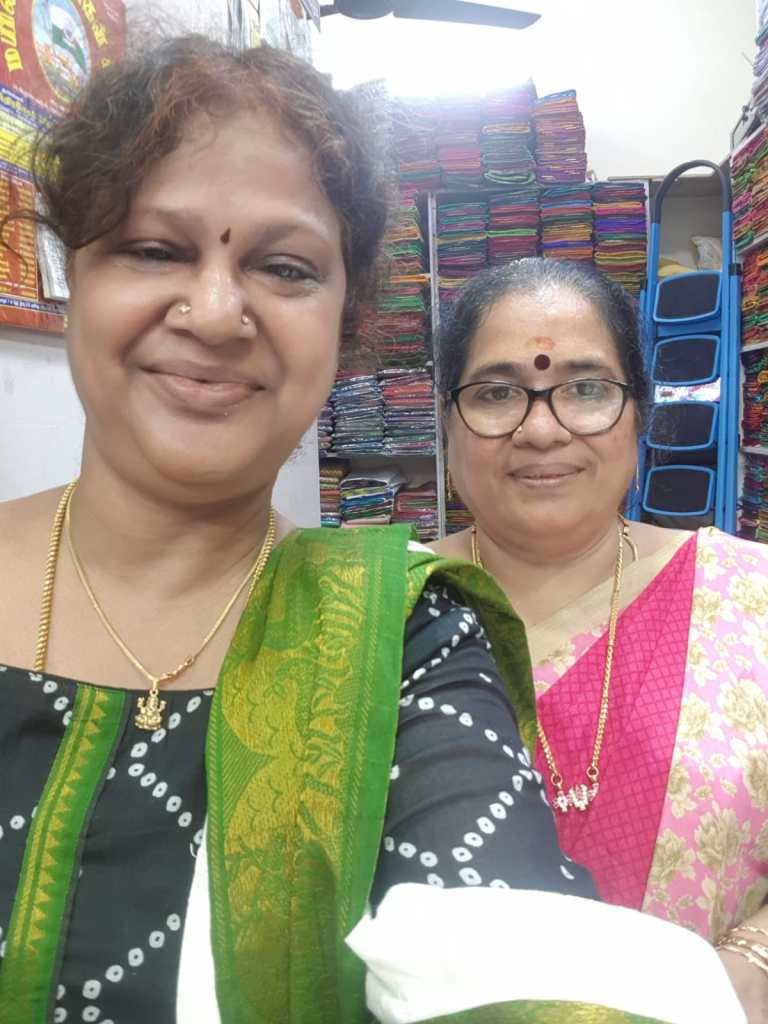
So now that the store has moved to North Mada street and is more accessible than ever before, I was here last evening to shop for Navratri. Shocked to see the owner hanging in a garlanded framed picture in the even more cramped place where his missus was in the cash counter. I asked her gently about him and she said that even though he completed his duties as a father and saw that their two children got married and settled in life, he left her alone as he succumbed to a massive heart attack one fine day. That was two years back. There were tears in her eyes as she said that. She is also a grandmother. Otherwise she said, she lacked for nothing. She never knew of textiles or sales. She was here after struggles and she was making it on her own. She was managing fine and she was carrying on his legacy. She asked me whether her husband ever gave me any discount. I hesitated but told her he normally gave me 10% off that she did too. I took it gladly because I was happy she was able to afford that. She is assisted by a strong team of young sharp girls who are on their toes. I remember their faces from years before. Not over 25. They must have received hands-on training from their erstwhile boss and owner. It was such a humbling moment for me to meet this fine and affectionate new-to-business woman who took on the mantle from her husband and was steadying her foot in a very competitive male-dominated world. The mere mention of her husband’s name moved her emotionally I could see. She is still grieving his loss. I asked for her name. Then I realized the shop was named after her: Rajarajeshwari cloth store. As usual I shopped for over half a dozen cotton saris, dozen blouse pieces, pavadai chattais for kanya ponnu etc. Her girls neatly packed everything and gave me extra cotton bags for the gift saris.
It is the kind of understanding that a fellow woman has for another woman: what we two shared yesterday. I was touched by the widowed woman’s love, affection and respect for her husband who was no more. It scared me a little to think of her position. That made me see her vulnerability even more. But she was doing a fantastic job, working for the first time in her life after becoming a grandma perhaps, in her 50s. Its not a huge business with impressive turnover. But it was a decent job that paid well. We took selfies. She took one in her phone too. Moments like this humble us. For the owner and his wife, I felt something. May be the Mylapore connection. Only business interests we shared. But we seemed to have traversed some empty space. We seemed to have connected by some other way in the metaphysical. As fellow humans. This is our culture you see. The woman is not dating again. Not looking for another partner. Living in her husband’s memory. Family is everything. Carrying on her husband’s mission. Why should the world call us a patriarchal society. Nothing good, they want to leave in original shape without tarnishing. They have to contort anything holy and make it vulgar. Sacrilege is the new rationality and justice. As old values live and genuine warmth and familial relationships appear to be not just thriving but get celebrated, I found a new hope for the tomorrow. May be not all is lost. I bid her goodbye. In her I earnt a friend. This sweet down-to-earth woman is someone who I shall go back to. #humansofchennai
 vijiravindran's