(Repost of original blog entry of same title of date March 28, 2016 with due edits)…
***** ***** ***** ***** *****
‘Gandhi Kanakku’ in colloquial Thamizh translates to ‘Gandhi’s Account(ing)’ or ‘Gandhi’s calculation’ literally.
The origin of the dubious phrase remained vague. In Tamil Nadu, it was figure of speech widely in usage wherever accounts would not tally proper or when there was something fishy preventing closure (of matters). Bad debts/losses that could not be made good or ‘write-offs’ were referred to as ‘Gandhi Kanakku.’ A loan never returned. A hope lost. That was Gandhi Kanakku.
Why Gandhi. This kept playing at the back of my mind. Where was the connection and what was the logic. How could one attribute something as ominous as ‘Gandhi Kanakku’ to the Father of our nation who led us through the independence struggle with his non-violent Satyagraha.
This intriguing post cleared the air for me with respect to Gandhi Kanakku. How much of this is irrefutable fact is debatable. What follows is my good guess work with little evidence (sort of):
V O Chidambaram Pillai (aka VOC) was the first Indian to float a Swadeshi shipping corporation contesting the British which earned him the title ‘Kappottiya Thamizhan’ (the Tamil who floated a shipping vessel) in the year 1908. A lawyer by profession from Tuticorin (Thoothukudi, Tamil Nad), he was sentenced to hard labour in prison for a whopping 40 years during India’s freedom struggle movement. He was with Indian National Congress but was influenced by Bala Gangadhar Tilak and others (who Gandhi could have termed extremists) and fell out with the party on his release (granted early in 1912 before Gandhi’s return to India for good from South Africa).
When Pillai was behind the bars, his law practice licence was suspended by the British government. In the prison he was yoked to work the oil mills manually in the place of a pair of oxen, which made the Tamil poet-patriot Subramanya Bharathi shed tears of blood by way of verses,
(Did we raise this crop with water? No, Oh Lord, we nurtured it with tears! Can you let it wither?)
VOC ‘s health suffered, and family with it, which could have made him enter a plea bargain with the British (guess). Pillai’s legal licence was restored but he was barred from practising in Tuticorin. The shipping company had been liquidated in his absence from the scene, incurring huge losses.
V O Chidambaram Pillai and Subramanya Bharathi, the stalwarts of India’s Independence struggle in Tamil Nadu, hardly find a respectable mention in Indian history text books.
South Africa had a sizable Tamil presence, with Tamils having migrated to the continent as labourers chiefly who progressed to one of leading and successful (Indian) communities with whom Gandhi was well acquainted during his lengthy and remarkable residence there, when he represented Indians as legal counsel. The South African Tamil contribution is significant in the African nation’s struggle against Apartheid after Gandhi left for India.
Gandhi could not have made (personal) use of the donations given by South African Tamils meant for VOC’s family who were direly in need of help (the financial assistance amounting to some 5,000 INR, a fortune in 1914), but it is possible he could have held the funds and used the same for Cngress after (V O) Chidambaram Pillai withdrew from the (Congress) party. A chief reason could have been that Pillai was a Swadeshi like Tilak, Bharathi and Bhagat Singh.
Thus the account that must have been settled by Gandhi on his return to India from South Africa with V O Chidambaram Pillai was allegedly never settled. Hence the colloquial phrase that audaciously persists from the 1910s to 2010s – for over a century. Over course of time, the common man lost track of the origin of the word-phrase. No explicable rhyme or reason persisted. Nevertheless the idiom survived in the parlance of spoken language.
Let us take the case of Vijay Mallya We can say his bank loan repayment is now, Gandhi Kanakku. An other global Gandhi Kanakku: Lehman Brothers. What say Gandhi-bhakts?! ‘Gandhi Kanakku’ is like a local legend in Tamil Nad.
If indeed Gandhi had denied the legitimate and timely help to Pillai, then it must be viewed a grave crime. Pillai braved what no other Indian could dream at the dawn of the twentieth century. He spearheaded a bold and trendsetting Swadeshi movement in the south, sailing the first ever Indian merchant vessel, challenging the British.But Gandhi’s supposed treatment of Pillai is hardly surprising given his stern views on Bhagat Singh.
Did Gandhi dare to call the British ‘terrorists’ after the Jallianwalah Bagh? This is the flip side of Gandhi just like he remained indifferent to the interests of the South African natives who were ‘kafirs’ to him for a very long period of time (up until a little while before he set sailing for India).
Having read of his South African sojourn (‘Gandhi before India’ by Ramachandra Guha) I still hold Gandhi largely responsible for the state of affairs India is in today. Indecisiveness. Dilly-dallying. Complacency. That sums up Gandhi for some of us. Doubtlessly Gandhi was Mahatma, the Great Soul, with his endless patience, perseverance and his non-violent preaching all of which have more relevance in today’s world than ever before. At the same time, it might have been highly arrogant on his part discounting others’ ways and means of spirit and honest-sincere-selfless efforts as ‘extremist,’ overestimating his own false and fake ‘decorum’ with the British that was neither necessary nor helpful. An uprising could have easily dislodged the British from India, long before 1947.
Could Gandhi-Nehru have bet Subhash Chandra Bose to gaining independence for India by sheer strategy? The duo legitimized the British colonization-occupation thence. They gave the Angrez a face-saving honorable exit that Bose would not have. Win-win for both Gandhi-Nehru and the British.
Meanwhile we continue to refer to unaccounted money as ‘Gandhi kanakku’ in Tamil Nadu. Lately the 2G scam (starting with Bofors ) and others have joined the list. Remarkably all the involved parties are Gandhis (sic) (originally Ghandys these) !
Should Gandhi’s philosophy be applicable today, then the Indian State must be disbanding our armed forces and surrendering without terms to Pakistan and China to wait for them to relent in their own sweet time. In other words, Gandhi’s ideology should make us ‘sitting ducks’ direct in the line of fire. This is the ground reality Mr. Guha. Is Gandhi beyond reproach???
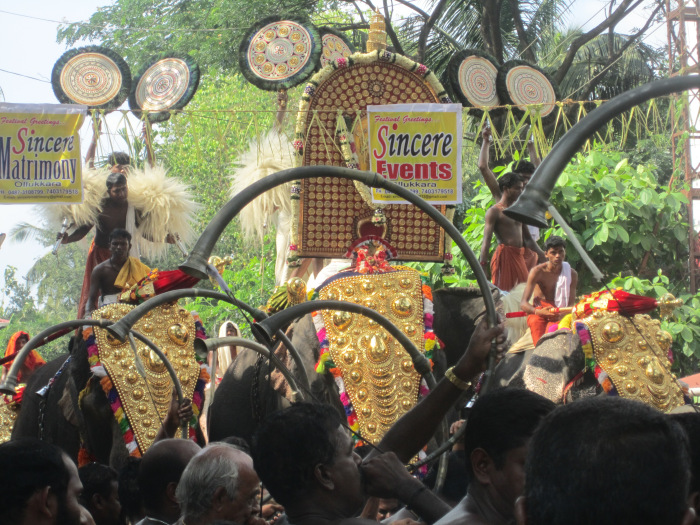
some 5 elephants, 3 in the front row and 2 behind for Sri Bhagawati temple vela (pooram), cherukulangara, Thrissur – day March 28, 2013
(Originally published the 7th of April, 2013 in a private blog . Edited and Reblogged )
I have always been awed by the Pooram festivals of Kerala, my neighbouring state. The most famous one that attracts hordes of both local and foreign tourists is the Pooram Festival of Shri Vadakkunathan Temple in the town of Thrissur. This mega temple festival that falls in the end of the month of March stars over a dozen elephants parading the Temple Deities in hot, merciless summer sun of India to the loudest blares of ‘Pancha Vaadhyam’ – the five traditional desi musical instruments comprising drums and trumpets.
A devout Hindu, i am at loss to comprehend the logic behind this heartless, mindless cruelty inflicted upon these most beautiful and wisest beasts on face of earth, the elephants, in the name of religion.
Imagine what could happen to jumbos trotting barefoot in intense heatwave of over 40 C (over 100 F) with capstans weighing in tonnes on their breaking back, in front of tens of thousands of frenzied crowds to the ear-splitting thumping of the Pancha Vadhyam, with firecrackers bursting nonstop through the celebrations? Won’t the elephants feel claustrophobic in the first place for their size, away from their natural wild habitat?
During one of my trips to Kerala, I could attend the Pooram festival of a very small and beautiful temple in Thrissur – the Bhagwati temple of Cherukulangara. Even in this small event, some five elephants partook in the festivities. March was closing with April starting, and already the mercury was rising rather menacingly.
In the evening came the rudest shock: I was in the temple where in the backyards i saw the five elephants with feet chained loosely (the elephants i must admit looked healthy, well fed (which was a small consolation) and were not chained stiff; they could still amble about and i was relieved they did not look alarmed or disturbed. While Shakthi and Shiva are who I look upon like my beloved, respectful and benevolent parents, I wonder whether the same Mother Goddess of mine and the Father would approve of such inhumane torture and cruelty meted out to defenceless elephants in the name of religion in their holy abode.What is this other than man-invented frivolous ritual? ) The elephants were quietly feeding on leaves and fruits and seemed relaxed that somewhat pacified me. Given the hysteric beating of drums and the creaking of loudspeakers in highest decibels, i was slightly agitated. After all it was my first ever LIVE Pooram! (In Bhagwati temples (Devi temples), Pooram is referred to as ‘Vela.’)
Elephants are mammoth species that subsist on vast swathes of moving space. That is how nature makes them as well as any other wild life: nomadic and free-spirited. How claustrophobic the gentle giants must feel within the confined spaces and congested quarters with granite flooring and barred ventilation, having been ‘tamed’ and ‘taught to obey’ with the ‘tanda’ (stick)?
The time was around 7 pm in the evening and then started the fireworks. My heart skipped a beat but maintaining a cautious distance from the elephants I still fixed my gaze on them to check if they were okay. Thank God a million, the elephants seemed disinterested in the noise, the sound, the fanfare and continued feeding, unperturbed by the 500 wala and the 1000 wala crackers lighting up the skies for the next 1 hour or so. I went back to my friend’s house in haste and even from a distance of 1 km could hear the bursting of the crackers.
That night my friend, a native of Thrissur, and I were talking of the fate of elephants in the country for a long time. Mad pachyderms running berserk, going on rampage in our temple towns is not rare today in India especially in the state of Kerala. Under-fed in many cases in unbearable heat conditions, with their ‘mast’ season ignored and mating denied, where and who else can these giants vent their ire on?
What is the point in touting that some of us are vegetarians if we can knowingly inflict so much harm on other living species without an ounce of guilt.
Very few countries in this world are blessed to have elephants as native beasts and India is one such a rare country. I feel blessed for this reason that ours is this ‘Punya Bhoomi’ where lions, tigers and elephants roam freely perhaps only next to Africa. We are lucky in the sense that in spite of all the self-inflicting damages we do to ourselves, we have a few of them still (luckily)surviving (and even flourishing as in case of Bengal Tigers and Gir Lions) to this date. The Moghuls, the Maharajahas and the British occupiers have all had their share of trophies and the cheetah is long gone extinct since the British Raj days thanks to relentless hunting. A few leopards are all we are left with in the extended cat family. So its the first and foremost duty of every Indian citizen to ensure that these elephants, tigers and lions and leopards are treated with utmost care lest they might go extinct right in front of our eyes. And in the event of such a worst scenario becoming a reality, we can not excuse ourselves ever for the deliberate lapses that we never try to correct… I for one thing cannot imagine an India without elephants… its too much for me… But the wild life population in India is dwindling at an alarming rate. Often I wonder, why God did not plant elephants as native species in America and/or Europe where they might be loved and cared for and best looked after (in present times)?
Do we Indians realize what a bountiful gift God has bestowed upon us? What an insensitive lot we are…
While i have been awed simultaneously by the Pooram festivals i have watched in television over years, somehow it’s always been playing in the back of mind that this madness must stop sooner or later, at any and/or all costs. Grateful to acknowledge, a good number of Keralites share a similar line of thought as mine. Except perhaps for the temple ‘Devaswoms’ of Kerala and a few oldies, i don’t believe anyone wants this ritual to continue with all their heart. Still it is even more complex now than ever before to draw curtains on this cruel custom as even churches and mosques in ‘God’s own country’ have joined the bandwagon to count on elephants to find an expression for their overt-religiosity.
I have not been to the Mysore Dushshera either which is held annually in the Mysore Palace Grounds on the final Vijayadhasami day of the 10 day Dushshera Festival (as Navrathri culminates to the climax closing throughout India), one of our major national/religious festivals.
In the ‘Dubare’ elephant camp in the state of Karnataka, i was told the elephants in the camp would be partaking in the annual Mysore Dushshera. To be fair to our Forest Department, i concede, the elephants in this camp looked healthier too and well-fed, taking a daily dip in the river Kaveri that flows through these parts.
Later I learned, elephant calves in the forests of Kerala and Karnataka are routinely trapped and captured for the sole purpose of domesticating them to serve in temple festivals and Mysore Dushshera.
I have taken elephant rides in Thekkady and Munnar in Kerala, where domesticated elephants are used for elephant safaris and admit that I have enjoyed these rides. I was of course told these are the elephants that strayed from the forest cover as young calves. The ‘kumki’ or the trainer elephants are sometimes used to tame those wild rogue elephants that may stray into neighbouring/bordering villages destroying standing crops.
There is elephant safari even in Singapore Zoo (last heard it is scrapped). In the zoos of Kuala Lumpur, Malaysia and Doha, Qatar, i was pleased enormously in the first instance to see the Indian elephants enclosures, a natural reaction. While in Malaysia, the elephants looked happy, in Qatar desert heat, the single lone Indian elephant seemed to be reeling under the extreme temperature and climatic conditions …. it looked so bored that I wanted to touch it and make it feel better … The elephants were gifts from India by the then Prime Minister Mrs. Indira Gandhi on her diplomatic visits to these nations. What a gruesome (!) idea of diplomacy. Are elephants private properties to be gifted or traded in?
In Mysore zoo, the elephants are faring better, thank god for small mercies. Perhaps this is the only zoo in India where the elephants are treated fair. Weather seems to suit them and they are breeding well. I have no complaints for a change on this zoo.
Even so the typical diet that a domesticated elephant may be fed with is not what it may chew upon in the wild: leaves and twigs and fruits and melons and even barks and shoots from trees and bushes. Instead what do we feed our pet elephant: jaggery balls and coconuts!
In Tamil Nadu, I am aware of some temples hiring elephants for festival season. As a young girl, I have seen bedecked elephants walking down our streets asking for hand-outs, led by their mahouts. The unthinkable scene of an elephant walking a busy street can happen only in India, even as cars and scooters ply by without stopping to take a second look… I don’t know whether to be amused by that or feel sad….
Man-elephant conflict is forever on the rise because the elephant corridor in India is shrinking at an alarming rate and the water holes that are feeding and breeding spots for elephants are fast drying up. The beasts therefore have no option than to walk into human habitat foraging for food especially in scorching summers .
Here is an interesting article on an elephant photographer:
I share very much the photographer’s sentiments – like for him, the elephant is my most favourite beast on planet Earth. I also worship (!) elephants hahaha because i am a Hindu and to us, all animals and plants and even inanimate objects that help us in our lives are Gods, and elephant is our special god Ganesha Himself and none other!!! I honestly see such a divinity in cows and elephants – may be because i have been brought up with such beliefs and may be because their benign nature seems to affect and touch my soul …
I can also understand fellow Indians’ emotional, spiritual attachment to elephants – most look at an elephant as a divine creature – which could be our greatest probem! And we are one of those families that still leave milk for snakes in Shakthi temples ! Our love and devotion and REVERENCE for animals is so very complex, complicated that we are causing them more of harm and making their existence miserable, a fact we are oblivious to.The monkey menace in New Delhi and other cities of ours and the wandering cows in highways of India are glaring examples of what blind faith can do to a population.
My sincere wish is that, let the Pooram festivals of Kerala go on from millennium to millennium, but please play up the ‘pancha vaadhyam’ – the 5 musical instruments to the hilt and free the elephants into the wild where they belong ! This is what Lord Ganesha will want you to do, fellow Hindus, Kerala temple Dewaswoms, will you ever get it? The Pooram festival and the hapless trained elephants are big time money-spinners for Kerala tourism. The mahouts have to be educated and weaned off the vocation in a phased manner first followed by rehabilitation. A very complicated and sensitive matter we have here at hands – that which could have repercussions on the thriving of the local economy: a socio-political issue that presupposes a careful strategy on in-depth study and a smooth maneuver.
For those who would like to make parallels between Jallikattu and Elephant tourism: DON’T. It is not fair or equal.
I wish we have legislation introduced in India forbidding training of elephants for religious purposes and processions and ban on elephants from being raised as pets in wealthy homes or from being gifted to foreign countries where their adaptation could prove to be traumatic given the hostile local environment. I wish there is a statute that prevents capture of elephant calves from the wild and one that returns the domesticated tuskers back to where they came from: the wild.
And remember elephants are NOT our toys to play with and use for our amusements. I am guilty as anyone here for enjoying the song ‘Jiya Jale’ pictured with the elephants in the background… but i wish this cruelty stops forthwith… enough is enough…
And what is the need to get elephant calves from the wild to be trained by the ‘kumkis?’ Let every single elephant calf or rogue elephant that strays into human habitat in this country be sent right back into the wild. Elephants are very much social creatures that roam about in groups, not ‘lone wolves.’ Separating them from their herds is enough to break their spirit in one swift blow.
Elephants belong in the wild, elephants are very wise, sensitive, sweet creatures… let them have their bit of private space on Planet Earth like you and me… its their birth right. Think of the world WITHOUT ELEPHANTS… can you?
**This post excludes the serious issue of Elephant poaching, very rampant in Africa and also to some extent in India (or generally Asia). Recommended reading: ‘The tusk that did the damage‘ – a fictional work based on real life events, authored by Tania James. Poaching for tusks poses the gravest risk to elephants of both Asia and Africa, threatening to drive them down to near extinction in a very short span of time in future – say some 20-30 years.
**This post neither takes into account the elephant deaths recorded in India due to electric shocks sustained from electrified fences of farmers (thoroughly illegal) and rail accidents in elephant corridors.
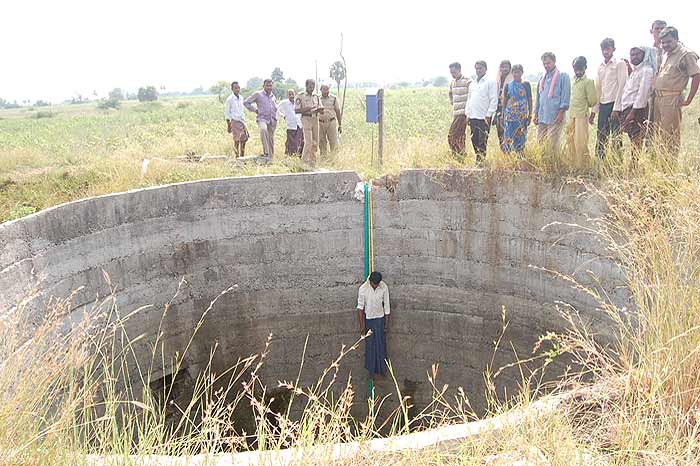
continuing tragedy of farmer suicide in India… who is responsible?
This is a post I blogged private (original date of publishing: August 6, 2014) but in the heat of ‘Jallikattu’ protests would like to revisit the issue: Below is a reproduction of my original blog post with little editing here and there.
‘Karuvelam’ trees also known by the name ‘Veli Kathan Mullu/Maram’ (the trees that are fences) were once the rage of rural Tamil Nad. These are easily breakable firewood found aplenty throughout the state. What we did not know of them was that, these trees were NOT native to India/Tamil Nadu. It was easy to have them in our villages for the dual purposes they served: cheap fuel and the much-needed thorn fencing they provided without requiring watering or nurturing. Veli Kathan Mullu was no fodder for cowherds/goat herds, unfit for grazing that made it farmers choice.
There is a conspiracy theory doing rounds in recent times, that in order to off-set India’s record farm productions, to make us a foodgrain importer, some vested ‘western’ interests got the species clandestinely to Indian soil. After 3-4 decades the effects – disastrous – are already showing. The water-table has since depleted to alarming levels and the rainfall to southern districts has receded to a bare minimum. Research established ‘the culprit’ behind the debacle of once-fertile agricultural farms turning into parched dry lands – the ‘Karuvelam’ trees ( botanical name ‘Prosopis juliflora’ ). There is also another theory going that Tamil Nadu’s Congress Chief Minister Kamaraj introduced the vegetation to the state in drought times to provide for cheap fuel in the countryside. Whoever is responsible, the damage is done and the effects are now devastating.
Now finally efforts are on to root out the trees completely from native soil and try cash crops first to air and test the soil and bring to it a fresh lease of life.
சீமை கருவேலம் எதிர்ப்பு இயக்கம் / Juliflora tree abolish movement.
This page is in Tamil and the posts in the page allege that the US is indirectly engaged in biological warfare in India, no less.
Links from the page (videos are in Tamil) explain how detrimental the trees are to Tamil Nadu agricultural holdings and even to our entire eco-system. Without mincing words, the page and videos blame the western forces for the invasion of these ‘alien’ trees in our midst.
LEARN ABOUT BT COTTON AND OTHER Genetically Modified (GM) CROPS/SEEDS AND KARUVELAM TREES FROM THE FOLLOWING VIDEO AND HOW A PLANNED ORCHESTRATION OF BIOLOGICAL WARFARE AGAINST INDIA IS ON FOR DECADES CHRONICLED BY THE WESTERN FORCES. (Wish this video runs subtitles in English).
One more on court order on rooting out of Karuvelam trees:
When the trees were initially planted in TN (none knows where they came from to this day), the villagers took to them eagerly given the level of our rural poverty. The ‘karuvelam’ trees saw to that the kitchen fires burned, literally, which was and has always been a major issue with rural India till this day. In ’70s or ’80s, the availability of fuel to far flung districts was scarce and the costs were steep. So the popularity of the ‘Karuvelam trees’ as fuel-efficient fencing trees in the state went unprecedented.
The Karvelam trees, extremely invasive, spread faster than wildfire and soon they spread upto river basins. Not only did they, over decades, suck out the complete water table from our agricultural ‘bhoomi’, they also preyed on the very moisture content in our atmosphere. ‘Tanjore delta’ is the ‘rice bowl’ of Tamil Nadu and now what we have is, farmers selling agricultural lands to realtors because of increasingly failing crops.
The wake-up call has come a little late, still better late than never.
Any similarities we have here with BT Cotton, a GM crop we have in India today?
For a fact we know how many farmer suicides are instigated in this country by failure of crops due to unpredictable monsoons. BT-cotton takes credit for causing maximum life loss in the states of Telengana and Maharashtra as well as in rest of India, being a direct import from the west (read US).
While I am hardly a qualified expert to speak on the subject, from what I have read and learned (from media) over years, I can surmise these facts:
BT cotton is a GM crop imported from multinational corporations in the west/USA. The seeds need to be imported at high cost from America whereas the local indigenous cotton crop seeds are distributed free to Indian farmers by our government.
BT cotton seeds are like ‘china product.’ One-time use only. Use and throw. Cannot be harvested for re-use at a later date.
Most Indian farmers harvest a good portion of the seeds for future use. This is not the case with BT cotton or for that matter, with any GM crop. The farmers’ independence and security are forever compromised.
The patent for the BT cotton seeds and other GM crops will always be the property of these corporates and thus not only our farmers but even the Indian government could one day come to be at the mercy of the west/ In short, we could be held to ranson as a nation. Food security is one of our strongest points. And if there is going to be threat for that basic assurance to our masses, then none can save India ever.
Recall the Hollywood picture ‘10,000 BC’ here and how the picture ends: the film’s hero character D’Leh returns to his tribe with success – and with a handful of gifted grains/seeds for harvest from his friends/allies.
Highlights how harvested seeds, native to the soil, are always important to any nation. The harvested foodgrains/seeds are India’s future.
The american corporations have scrounged millions & millions of dollars out of poor, dying farmers in India (watch the above documentary). Just like Amway did, like in rural Andhra Pradesh to cite a case.
(Amway India is another track i will take up later).
BT cotton, the GM variety yield may be good and promising in the first couple of years. Thereafter the graph drops significantly as we have seen in the states that took to BT cotton farming. Bollworm which plagues the BT cotton gets pesticide-resistant in a very short period that leads to subsequent crop failures. The fact that this observation was NEGLECTED to be mentioned by US marketing to India goes a long way to prove how aggressive our modern day invaders are. And how gullible or corrupt perhaps Indian government has been always, sadly.
Given the high cost of acquiring the GM seeds coupled with uncertain monsoons and inability to tackle the bollworm infestation, thousands of poor farmers have been driven to suicide in Telengana, Maharashtra and Gujarat. The other complication is, once the soil gets the BT cotton plantation, it turns averse/hostile to native cotton varieties. This is like cancer – our own genes on a mutiny against our physical body leading to our ultimate death and destruction.
BT cotton seeds is patented and held to ransom by US corporations – so if GM crops is what India is to go after in a large scale, we are now having a trailer of what is going to come next. The native harvested seeds will be lost forever with the ‘antibodies’ multiplying and multiplying to an extent that our own defences will be down and become the weakest – an unmitigable loss to the nation and humanity.
BT cotton is a small example of how the west can twirl us around their fingers. While I have never come across a direct case of BT cotton farmer, over the years I have been watching a no. of tv news reports and newspaper findings and researches that point to the scenario. I believe in them because they have no reason to lie. This is not like an isolated incident either. This is a widely spread critical issue that has drawn the national headlines for the right reasons.
This blog is in response to the one on GM BT-Cotton that I recently chanced upon. While I welcome others views, I am surprised and hurt to see how our own blood is turning against us for ‘short term gains.’ So this is how the British came to usurp entire India. They played one small ‘Rajah’ against another – his neighbour, who gave in to excessive greed and selfishness. In the end, they/we all lost and how they/we lost!
What about other GMO vegetables and fruits like tomato and brinjal. These GMO food can contain genes from pigs and cattle – which can have significant altering effects on the very metabolism of us Indians, leave alone our vegetarian/religious orientation. We know of the ‘Mad cow’ disease which is not a surprise when you go against nature feeding the cattle with GM feed that contains meat products among others. When the cows, herbivores by the law of nature, ingest something that their metabolic system can never agree with like meat and chicken formula, their genes only have to mutate awful and gory, do we have a choice. Who says the results are not proved in the labs. And why should not they ever be suppressed or forged by vested interests/multinational corporations. Imagine the calves being born to these GM-formula fed cows and the genetic havoc they can wreck/unleash in the process. Imagine these calves growing up into cattle, giving birth to next generation with their original genetic composition turning awry. So are they the cow or cattle we know anymore? Or are they wolves in sheep’s clothes literally. This way, the whole biological/ecological chain can be affected in a manner unthinkable – and who knows where this will lead the world to. No wonder the beef products from the cows fed on GM food lead to ‘mad cow’ disease. Okay, this is all my deduction only, hahaha.
Soya bean is another GMO product that we can all do without. Touted to be an anti-cholesterol food, local doctors contend, if consumed largely under 40 years, the soy beans can lead to infertility in men. Not 100% everything soy is GMO but the GMO Soy beans have invaded everywhere.
So what are the long term effects of GMO foods in us humans. Already we are seeing an unprecedented spurt in the birth of autistic and spastic children in the country which we blame on use of fertilizers and pesticides. They say, GM seeds/crops have not reached India in a big way, but everytime I see a big eggplant or whatever in the markets, I have these misgivings. Because, Indian produce are by nature diminutive in size compared to the western produce. Indian vegetables and fruits come in compact sizes with a detectable and favourable taste – because I have had chance to sample them and cook then in both Malaysia and Qatar for years now. I have had a chance to compare the same vegetables that are grown in different climatic conditions, different geographic locations etc etc. While my views can be easily dismissed as ‘coming from a housewife’ I have this ‘life experience’ that not even the experts in the field may have. So over-size vegetables and fruits in Indian markets alarm me always. Some stores sell imported ones – Personally I take a great care never to buy the wax-coated rich-looking ‘Washington apples.’ Rather it is always the demure and unattractive local desi ‘Shimla’ apples for me.
So essentially this is the difference between desi and foreign.
As for long term use of pesticides and fertilizers, we all know of the Punjab and Kerala story:
For one thing, Indian farmers are poor and mostly illiterate, and it is not easy to educate them about the ill-effects of indiscriminate use of pesticides and fertilizers. But the case of GM crops like BT cotton is altogether different.
Overall, it looks like there has been some systematic, concentrated efforts to demoralize the Indian farmers that can have a direct impact in our food production and national food security.
India is tired, fighting a lone battle – with no SAARC nation to give us support. We fought and won the ‘Basmati’ case, we are fighting for everything Indian and desi from patents for neem to turmeric (haldi) to everything while our neighbours would rather sleep over these life issues and save their energies for ‘Palestine’ that is of zero consequence to the entire Indian subcontinent. What a waste.
Remember the ‘keezhanelli keerai’ (a type of greens) that is Ayurvedic/Siddha medicine that has traditionally been used for centuries in India for treating jaundice (hepatitis). The allopathy medicine uses the same elements in this traditional greens – so what is India’s intellectual loss already is incalculable. Daytime robbery is what is taking place in our nation right in front of our eyes and we are all helpless watchers.
Today poor Indians are buying patented ‘keezhanelli’ – allopathic medicine – at exorbitant costs to get treated for hepatitis.
Every nation on earth has its own interests to protect first. So if the west would want India to be accommodating to their self-interests, India in a similar fashion reserves her right to enforce her stand in WTO to ensure the food security of this 1.2 billion nation. To ward off the BT crops and seeds will be our greatest challenge in the forthcoming years/decades. It makes one wonder about small, gullible nations that must have already fallen prey to ‘powerful demands.’
PS: I am not a farmer neither do I own agricultural lands (prohibited anyway by law from owning farmlands as urban citizen of this country), nor am I a qualified expert to speak on the subject. This blog is merely a matter of interest to me, a housewife, with no background. In fact I unearthed this one from ‘Trash’ and re-did it to post it today, as the issue gathers momentum at the center. I am NOT a member of any political party or NGO.


 vijiravindran's