MS Subbulakshmi is my heart’s favourite. Nightingale of Indian classical. This is from her concert in the UN in the year 1966 with subtitles. The composition is in Sanskrit composed by none other than the Paramacharya of Kanchi Mutt himself. Just listen and keep playing this in loop. It makes so much sense even today. Especially today. HIGHLY RECOMMENDED. No intention of copyright violation. Just wanted to share this beautiful rendering here in my blog because I have some impressive following! Om Shanthi Shanthi Shanthi Hi. We came with NOTHING. We are going to take back NOTHING. And NO MEMORY of this present life to our next birth.
Category: Socio-Cultural
No more IT exemption to Catholic clergy in India
In a landmark decision the Supreme court of India upheld the waiving of exemption from income taxes to nuns and priests of the Catholic church serving in educational institutions, thus bringing the practice from the British era to an end. The catholic clergy in all filed over 93 appeals seeking reversal.
https://www.ucanews.com/news/indian-court-ends-tax-exemption-for-catholic-priests-nuns/106944
This really made my day! #beinghindu
Sincere, academic and profession oriented, hardworking, going home straight from work than hitting a liquor bar, going home to family everyday, disciplined, selfless, sacrificing, family oriented, CULTURED in true spirit – truly these are the characteristics of most Hindus. This i am saying after having lived abroad on and off for a quarter century, mixing with foreign cultures. Mainly Hindus don’t disturb others and let them be. That’s a great testimony we have here.
If India is poor, this land is lived in for 10000 years and seen the golden age for centuries. The streets we walk in are centuries old. The temples we visit are 2000 years plus ancient. Poor in only aspects important to the west. NEVER POOR when it comes to what really matters. More than our streets, our lives must be clean. More than the material wealth, our lives must be rich with culture and heritage passed down for millennia.
Pathan
Sometimes, its hard to believe that these Afghans ruled India for a while.
As the Pathan picture gets into controversy, I would like to blog of what I know of Pathans. They are of Af-Pak origin and I have exposure to them in Middle east. Right from the airport you cannot miss them and they are tailormade for some semi skilled professions where they have made their mark. Our locality in gulf is mostly Pathan dominated although the labourers were moved to Labour city with all facilities for them at one spot as the city grew and the world cup preparations were on. I saw a few buildings torn down that were very old and were leased to big pathan groups and obviously the men have moved over to labour city. Otherwise, whichever part of the country you are in, you can find the pathans crouching and huddled together in groups in the traffic islands between busy junctions! Wherever I go for walking, again they would be there as gangs, sharing a common bread. I live in a housing colony where 95% of households are Indian. In fact that’s the reason I wanted to live here. You can opt to live in mixed community but there is the comfort factor. My previous flat was in a largely arab dominated apartment complex where I sincerely could not tolerate the beef smell that would ooze into my home from all directions. See, most people who talk about secularism just cannot understand a vegetarian’s delicate senses. Its not about hate for beef at all. Its that we cannot even stand the smell. I don’t find fault with others’ food habits. Its just my level of tolerance or intolerance that’s all. Moreover, you can be friendly with other nationalities to a certain extent. There are filippinos and arabs among others who are very nice to befriend. But beyond a point, that intimacy that we Indians share can be had only with those from India or with those of Indian origin. I am saying this because, I have instant rapport with Sri lankans, Nepalis even Bhutanese, Bangladeshi and Pakistanis. That kind of closeness I find only with people of the INdian subcontinent.
As for pathans, we find them very handy because they live among us in this locality. I could call them for any plumbing, electrical work or tank cleaning. I wanted Ikea for my kitchen here but when I was in India, my hubby cleverly booked our counters and cabinets from a pathan at throwaway price. Actually the quality is better even if the aesthetics are sacrificed! But my kitchen fittings have been serving me good for over seven years now whereas all the expensive posh Ikea ones that my friends got had to be replaced. There is an exclusive pathan shopping complex near where I live where you can find anything to everything such as nut and bolt and curtain rods to curtains, clothes, winter jackets, boots, fabrics, leather ware etc., etc. And yes even furniture and plumbing, electrical appliances. Rates are okay, and in fact much cheaper. So most of us settle for the pathan stuff as this is not our real home. We are living in rented place. Mine is a 25 year old flat but it is in ship shape except for some minor complaints. Our painting works get done by the pathans. The dry cleaning shops here are run by them. There are a few exceptions though: barber shops have been taken over by Bangladeshis and nobody can beat Indians when it comes to groceries and provisions. There are some restaurants run by pathans and obviously we can’t eat at them. However even the pathans visit our Kerala bhais restaurants to sample Indian food. My street would be flooded by the pathans haphazardly parking their trucks. Yes, mostly they are truck drivers. Or they drive trailers. Before world cup, my area was spruced up. Here nobody questions them. Their lifestyle is part of the community fabric. I miss them now and wonder wherever they went! Now the look of my street is kind of European! The roads are clearly marked and any wayward parking is ruled out. Mysteriously the pathans have disappeared. One reason could be that the free zones left for parking their trailers etc., have been converted into parks and parking bays for the world cup. They have since been closed to easy access. Without parking, the pathans cannot exist. So may be they have moved to wherever they have parking facilities. Some even sleep in their trailers.
The well doing pathans ( khans) are all mostly Indian! But I understand that the labour class pathans are also very rich – some of them, not all. They may be shabbily dressed but they earn handsome from subcontracts. They are in employment of major multinational oil and gas and civil construction and electrical and mechanical companies. They do tough job and get paid very well. I once saw such a pathan hold a family wedding in a star hotel where I went for a speech club program. They seemed out of place but they were real dressed well. Obviously a rich pathan!
But I would always wonder aloud, how simple their life is. They probably own not more than 2 or 3 sets of shalwar kameez. They eat from common thali their bread and biriyani. Beef is very cheap here so they have plenty of it. Their place of worship is everywhere. Their entertainment is gossiping in groups, as I said, huddled together in traffic islands! They go to public parks to access free wi fi to call back home. Their cost of living is way too low. Living conditions not that bad. I believe, most of them don’t even repatriate money to their native countries. They go home once an year to their families, get their wives pregnant and come back happily to resume their life in middle east. By the time their sons may turn 18, you can find them join their fathers. Family business! You need people of all kind to carry on with normal life. so many, many invisible links in the chain that make our life livable. Pathans to me are one such a main connection to comfortable life in middle east even if they are hidden from public view. If you drive down the desert, you can see the old bedouin settlements leased by pathans. Out of nowhere these camps crop up. Their job in the great arabian desert is to rear the camels and tend to other works in the area. Highway drivers to some 99% are the pathans. Nobody can handle trucks and trailers like them! In India, its the Singhs (Punjabis).
Pathans in India are comparatively very well accomplished and doing a great job. Of course not all pathans are blue collar workers. Back in their own countries, they must be prospering in all walks of life. In middle east or anywhere, the Indian domination cannot be ruled out. Indians bulldoze every other nationality frankly with their immense talent pool. We reduce others to middle level or lowest levels of employment and that is what I always think when I see the pathans. But as I said, we need men for every job. Pathans carved their niche in middle east with their tremendous appetite for manual labour and semi skilled jobs. They are best at it and most reliable.
Generally Indian women stay careful with pathans. Not because we fear them. We in middle east have to always keep in mind that we are dealing with men who don’t get a chance to be with women for years sometimes. They don’t booze either. So to be on safe side we are weary of pathans who we engage for all kinds of work at home, that’s all.
One pathan gave me his visiting card knocking on my door telling me he lived just the opposite of our compound and that he was available 24 hrs for carpentry, plumbing, electrical works and house painting, tank cleaning etc., etc. He went door to door giving the card but I was really impressed by the interest he took in his business. The details printed in the card had so many errors still, that was a wonderful effort!
I have a soft corner for the pathans always because they work so hard and they are very contented in their simple lifestyle. My hubby jokes in my previous janam I was a pathan (before 1947) and probably a Kashmiri or Paksitani Hindu (before 1965) who got massacred at the hands of Pakis. So in my present janam I was graced with a birth in proper Hindu dominant India. But my affection for pathans is proof that I have karmic connection with them! Our Indian husbands can be impossible. My hubby would dutifully point out pathans to me wherever we drive and say, ‘look your cousins!’ I would say had I married one of them, my life could have been simplest and happiest! Very few pathans have their families with them in middle east and those who do are considered pretty wealthy. They live here for generations but they are not citizens.
The Khans of India must realize how well placed they are and in fact fortunate that they find themselves in the other side of the border. I would not like to stereotype the pathans but the truth is, the exception is a miniscule percentage. Most have no education but aren’t concerned either! Or may be their sense of righteousness is better than ours. Perhaps their lifestyle is far more peaceful. But then why are their nations so war torn.
Even last evening I went to a pathan shopping place. Almost all shops here are owned by the pathans but the Bangladeshis have been steadily taking over their spots. Except for the truck and/or trailer driving, the Bangladeshis have forayed into every single sphere of the pathan stronghold. They are much smarter, more intelligent and hardworking. Their physical strength cannot match the pathans which is why they have left out the driving of trailers I guess!
Meanwhile you cannot even find much of Indian manual labour, as Indian labour is very expensive and Indian community has moved much ahead in the ladder, with being placed in executive positions and professions. I have watched pathans salute many times Indian men with respect. Pathans do hold Indians in respect. That respect comes from the Indian’s social hierarchy. We all do our bit in my opinion and we can coexist in this world filling gaps in each other’s hemisphere.
I have heard of gossips about pathans but I can’t obviously share them here. Crimes happen everywhere. We, especially, women have to be vigilant because whatever said, we are still vulnerable.
Once long back we dined in a fine Afghan restaurant. On seeing us the pathans did not know what to do. They had a sumptuous hot bread basket and surprisingly a couple of veggie dishes. It was my son’s idea really and this eating place looked upscale. The breads were too good from the land of tandoor. For subzi I ordered a bindi stew. The men went for a lamb dish. We weren’t given plates and we were expected to tear into the bread and dip it directly in the subzi! We made a special request for plates. The staff were amused but gave us individual plates as Hindus never will share a thali. For us its abhorrent.
Brings back memories of a group of pathans in Dubai terminal waiting for their flight. They had a 20 hour transit. They were all hunched over a mammoth paper package that was thrown open. A dozen hands reached into the biriyani at the same moment! That comradeship always would impress me. But my hubby as usual came with a retort. ‘You know why they have that custom. In olden days like mogul times if the food may be poisoned, it was to ensure that everybody died the same time!’ Trust was deficient he said because, Aurangzeb killed his own brother to ascend the throne. Whatever, I was looking at the pathans sprawled in the airport floor without a care in the world, not bothered who is looking, who is not. Snoring loudly they went to sleep fitfully! I wished life was easy and uncomplicated for me!
The Nightingale Calls It A Day
My school days went with the Vividh Bharathi timings. 7.30 in the morning meant ‘Sangeeth Saritha’ by which time my mother would already have left for Mylapore tank to board the PTC bus to her school. In fact walking her up, my father would have returned home by the time the olden goldies based on Hindustani raags would start blaring from All India Radio. A half an hour of Rang Birangi or something would follow, essentially Hindi oldies but tuned to Hindustani mostly. 8.30 would be the time I would leave for school, and when my father would leave for his office.
Afternoons on holidays would always be with ‘Man chahe geet’ between 1 and 2. Would never miss that precious one hour for anything. Evenings there was ‘Chaya geet’ between 5 and 6 that I would miss mostly. However there were times I would take the transistor to my terrace and let it play my fave hindi songs. Bed time or dinner, if I would have finished studying and if awake, ‘Aap ki farmaish’ between 8.30 and 9.30 would be allowed. Rest of the hours, our radio would be mostly tuned into Sri Lankan Tamil broadcast.
I have to say, my parents and grandparents shared my love for hindi oldies. Or probably I acquired my taste for Hindi from my family. My mother loved Rafi and Lata as much as she loved Tamil filmi. In fact she was one step ahead of her peers, being a huge fan of Runa Leila and Nazia and Zohen Hasan towards her last days. May be the year was 1981.
Memories of watching hindi flicks with my family stay afresh in my memory. From Bobby and Sholay to Hum Kisi Se Kum Nahin, we left nothing screened in good old Madras. Sholay I and my sister watched with my mother and chithi before my cousins were born, at old Satyam theatre.
Although in India we get exposed to a variety of music including authentic ‘agmark’ classical to Bollywood and regional to folksy, I have always felt that the Hindi music is by far exceptional. Or at least it used to be. It had a soothing effect on our soul. Tamil typical classical and Sangam, i have found to be not that very relaxing. You need to be alert to listen to Tamil. Not so with Hindi which is much more mellow and soft on your ears. Aesthetically probably Hindi language has an edge as it’s kind of culmination of cultures.
Rafi s’ab, Kishore Kumar and Lata Mangeshkar were the quintessential trio who brought in so much of popular hindi music and happiness to our lives among others. It may be only filmi ghana yet it mattered. Even today their romances remain timeless classics. I am listening to them some 50-60 years later. Lata in particular has sung some desh-bhakth songs as well. There have been criticisms against her for blocking younger talent and those from the south like Vani Jayaram, but after listening to her voice in ‘Valaiyosai’ in Tamil, a duet with SPB, I concluded that Lata was indeed the uncrowned queen of playback singing in India. Others were leagues behind her. I don’t deny today we have Alka Yagniks to Shreya Ghoshals who are good and special in their own ways. Yet Lataji is a legend, a saga. I wouldn’t say we would miss Mangeshkar as we already have the younger lot trying to fit in in her shoes. What I would say is, it feels like a grand old tree uprooting and giving away, that’s all. The shade where we rested and had taken for granted, will be there no more.
The Swamy Photo Shops (Swamy photo kadai)
This is not about photoshop but about shops that sold photos or pictures.
We Indians are way too familiar with photo shops that line our temple streets and the temple towns where framed pictures of Hindu deities of all sizes are painted-printed to be sold for a price to the devout. Practising Hindus revere two relics in the puja (home service or altar): framed pictures from the photo shops and/or ‘vigrahas’ (small stone/metal carvings/sculptures/idols). We inherit some as heirlooms passed over for generations in the family; we go for the latest prints of our deities as well to suit our home decor. There are then the laminated ones for our desktops. There are photographs from temples of the murthis as well. Photo shops cater to our devotional cravings and there are some of us who are even ‘collectors.’ I have friends who boast of collections of Tanjore paintings that have been the rage for some time. Personally for me, the Tanjore art is for aesthetics never for Puja. Nevertheless, I love to browse through these religious photo shops that have a variety to choose from: the black & whites to enameled and embossed works with silver and even gold filigrees. Gods and Goddesses at their finest! I have even feasted my eyes on rarest depictions of Raam, Lakshman, Bharatha, Hanuman in which Raam is not at all looking good! There are antique finishes in photo kadais although now I am not sure whether the faded look is manufactured digitally these days. I wonder where the sepia tinted Lakshmi and Saraswathi from my parents’ home went. The ageing of those pictures was natural lending them an ethereal look. I do now have the Raja Rajeshwari like a reigning queen in my puja, from my in-laws home that has been with the family for over a hundred years. I have not retouched it or tried to restore it. I merely changed the frame as the old teak one had given away and the picture was exposed to damages.
As a Mylaporean, I have spent hours and years walking in the four Mada streets looking at the swami photo shops. Dutifully every morning on way to school I would say a small prayer to all the deities that graced us girls from within the wall of those shops. The frames then were wood. Now what we have for frames is either metal or plastic variant that however comes with a wood finish. Except for the artistically done Tanjore painting that is hoisted over teak frames, none else merits a wood frame these days.
The city has swami photo shops in every locality but it is those in Mylapore that are always special to me. I also have the habit of getting at least a small photo or vigraha from whichever temple town I visit like for a memento. My Puja articles such as bronze/copper diyas, deepa aarthi etc., are from the temple town of Tirupathi. In my parents’ family, always the puja paathiram (articles) for the newly wed were gotten from Alarmel Mangapuram in Keezh Tirupathi even if we daughters of the family were also gifted another set in sterling silver (as ‘seer’) (that we would secure in the bank lockers to use only for our kids). Years of hoarding small framed pictures and vigrahas have added to my collection and now my puja has become a bit staggering! Not really, but I wish I could keep it modest. However, every swamy photo in my puja can tell a story. Nothing was bought over the counter like a commodity. Guruvayurappan came home for instance from Guruvayur, where in 1996 I and my husband gave ‘tulabharam’ to our son in the temple. By the way, the kadai veedhi of Guruvayur is spectacular with the perpetual air of festivity about it !!! A second time, I got a small pair of Kerala kuthuvilakku from the same Guruvayur sannadhi street.
Tirupathi sannadhi street/kadai veedhi was a craze for me when we used to go to the seven hills every year for a darshan. My Mallikarjuna is from Sri Sailam, Kanaka Durga from Vijayawada, Udipi Krishna from Udipi, Mookambika from Kollur, Sharadhamba from Sringeri, Lalithambika from Thirumeeyachur. Satya Narayana was lovingly gifted by my Chithappa (as I observe the Pournami vratham) who also with my Chithi gifted me the first ‘traditional five’ photo: Pillayar, Lakshmi, Saraswathi, Murugan and Perumal. We all start our life (thani kuduthanam) with those basic five in single frame! No business runs in India without these five who are important for success in any and everything. Another prized frame is Lalitha Parameshwari, printed from handdrawn painting by the Sringeri seer. That edition is sold off now. Our Arni Perumal (from the Shiva Vishnu temple of our family whose presiding deity is Perumal, with Shiva in a small sannadhi) is juxtaposed against Tirumala in a framed picture in my puja, due credits for which go to a cousin for his literal photoshop work. Arunachaleshwara is from Thiruvannamalai. I have Varahi from the Varahi homams I attended for years every Amavasya. I have Sarabeshwara again from my chithappa both of which I was discouraged from having. A believer in forgiving gods and never in punishing ones, I went ahead with having them and they are with me for over 15 years now. In the Padikasunathar temple near Kumbakonam, the archaka returned our mint fresh 10 rupee notes after placing them in Shiva’s feat that I framed for puja. Looks as if I am worshiping Gandhi, but then why not. Love him or hate him, he was an exceptional humanbeing. Perhaps not a cult guru but a guru nevertheless.
There is something in our family puja (in our community) that is not sold in shops, and this the shivaite sign of our family tree representing our Kula deivam. My mother used to do ours in a wood block anointing it with turmeric and vermillion but i decided to paint my in-laws’ heritage in yellow and red symbolically in a piece of wood. This is a distinct mark of our lineage and although now I am trying to wriggle out of these binding roots, I respect and revere them immensely. Our Arni ancestral home is like a repository for aged swami photos handdrawn and/or painted originally supported by teak or rosewood frames. I picture the great grandfathers and their wives and families in this house whenever I visit. The palatial home had once mounted within its high ceilinged, beamed and pillared spaces, original Ravi Vermas. Or perhaps very first copies from an era when colour photographs were still leagues away.
There are connoisseurs of God’s pictures like these. Serious collectors. Like those who go for offbeat Meenakshi Sundareshwara, Kanyakumari, Ma Durga etc . I recall Devi names among other protective avatars during my everyday puja. The deities whose names I chant aloud have surprisingly made their way to my puja. That is how Annapurna reached me from Kashi/Varnasi, and Vaishno Devi reached me from Kashmir. I have even Pashupathinath from Nepal received as gift. These last three are in my puja in middle east. I love looking at puja of friends. I love the oldest/ancient pictures and the inheritance mostly. Tanjore paintings are not really my cup of tea. They do not serve the purpose being ornamental, so far as I am concerned. But I do have two. My chithi chithappa gifted me the baby Krishna for housewarming. My friends gifted Radha Krishna for my son’s wedding. Tanjore art though brings in good vibes.
An important itinerary of my girls gang temple tour is a walk through the mada veedhis or the sannadhi streets of our temple towns, taking stock of framed pictures, antique shops, trivia shops that sold the old parama padham, pallankuzhi etc., the bronze and the copper shops, the claypot shops. I love this kind of nostalgic trips always. With friends, it is even best. It transports me back to the 80s. For Kabali temple utsavam, my grandma used to give me two rupees every year. I used to buy peacock feather from the gypsies with the money. Now i greatly regret it. How many peacocks were forcibly plucked for their feathers! But the thiruvizha kadai veedhi on utsavam days still stays fresh in my memory. The ‘theradi.’
A visit to the temple where I used to frequent every single day of my life until I married washed me over with memories of photo shops. This is still good business as I noted. I walked into one and picked up a bright print on impulse. The shopkeeper asked me if I lived nearby. I said, I did until 28 years ago. Some of my swami pictures are from this shop – the ones that my chithappa gifted. I told the man I used to stop even at this shop everyday for a quick blessing from the divine on my way to school. The owner chuckled saying it was common in those days.
I thought how many small trades India supported. How many varied occupations survived in India, the likes of which you cannot find in any other corner of the globe! How innovative! I think the charm of India is this. I just did not have the heart to move out of the small shop where there was hardly room for more than a couple to browse comfortably. I wanted every single picture of God from the shop! What a beauty is this Sri Rama Seetha Pattabhishegam. I remembered I still did not own one! The dull finish handpainted one was priced at 9k so for the moment I have postponed my swami photo shopping urge. There are many, many more like for instance the Shiva family. The romantic Muruga with Valli Deivanai with the peacock making a beautiful backdrop – a rare angle handpainted frame. Krishna grazing and playing flute. Bala. Lalitha. I loved the different depictions as well, not the conventional always.
Swami photo shop windowshopping reminded me how retail therapy alone is not solution to everything (for bored housewives especially)! At the end of the day. our heart knows what matters. We embrace peace without even knowing it. Most of us underestimate ourselves rating us as materialistic. In the swami photo shop I was thinking like, how i wished i could have one and all of the swamis and a big, big puja and nothing else in life. For a moment, that is the way I felt. My one regret in life is my apartment living where I do not have a puja room. I have to make do with a puja cabinet, that is all. It may be ok, but the swami photo shop reminded me how selfish we are to relegate a mere corner space in our home for our puja. In my parents home as well as old joint family home of in-laws, the puja was a separate room with a door and padlock.
I have decided to repeat the swami photo shop strolls in future at regular intervals. I do not mean in this context the latest showrooms catering to our spiritual needs like the one we have near Kabali temple. I am referring to single standalone swami photo shops that specialize in swami photos and framing. These are another category.
I love the kumkum, chandan shops as well. The archana thattu shops. The glass bangle shops. The flower shops. The thengai mandi. Arisi mandi. Woodpressed oil stores that are now back in business. Coffee bean grinding outlets. Now even Mylapore has deteriorated beyond recognition. Gone is the kind of temple town situated around the tank and temple that we grew up in. Yet those like the swami photo kadais survive against all odds retaining a stubborn foothold in the competitive world where to stay alive is phenomenal. The swami photo kadais are one of the last bits of connection some of us retain with the old world we have lost: that of our parents. I felt such a swell of fulfillment last evening having spent half an hour in a swami photo kadai and an hour and a half in a spiritual store, the kind of which we normally derive from a hearty darshan in temples.
Malaysia Open House.
Not everything is fine everywhere every time. We can only roughly speak of the average expected scene. Standard deviations characterize every homogenous sample. Statistics is all about this small but strategic variance.
Our time in Malaysia saw us celebrating Diwali in this south east Asian nation: 1997-2001. Exactly two decades before.
Malaysia is a potpourri of cultures. So much diplomacy is involved in maintaining the delicate balance naturally. Three mutually exclusive ethnic groups with nothing in common except for humanity. How do you keep going
There are injustices inherent in the fabric of any society and Malaysia is no exception, but that is made up for with the industriousness of the population. Malaysian citizens make conscious efforts to overcome the differences in the interests of their nation.
Malays, the bhumiputras (going by ironically the sanskrit name) are the sons of the soil who have reservation in universities to government positions. They are licensees for businesses without whose shareholding stake, you cannot run a profitable venture. You can of course keep your malay partner dormant opting to merely transferring a ‘cut’ which is kind of regular practice there. This is how things operate in this country. Indians and Chinese were brought to this tropical nation to work the rubber plantations and palm and tea estates, by the British.
In 1969, Malaysia saw civil war and blood ran like a river in KL, they say. With that our friends told us that they swore never to repeat the bloody saga again. For the motherland’s sake the malaysians decided to go for peace and harmony.
Malaysians interwove new national customs and traditions into their social calendar rug to keep themselves warm and snug in friendship and cordiality. One such invented local and original custom was hosting ‘Open house.’ Not limited to a particular community, all the three ethnic groups of Malaysia viz., Malays, Chinese and Indians would have open house for their major community festival. It meant, the Malays threw open their houses to the public for Eid (called Hari Raya in Malay), chinese for the Chinese new year and the Indians for Deepavali. An open house meant, any stranger could walk in to the host’s place and he/she would be toasted to a feast. Malaysians would have a lavish spread of their native cuisines as also continental to suit every palette. Mostly the open houses began as brunch and extended well into late evenings. In kumpungs or hamlets, the crowd turning out wouldn’t be excessive. You could expect a number. In cities it was always a challenge for the hosts. The chinese and malay open houses were popular for their meat and seafood fare. The Indian homes were famous for namkeens and mithais, our traditional laddoos, jelebis, murukkus etc., apart from the curry masala.
In 1998, we were invited to one such a Diwali open house by an affluent chettiar family in KL. Their extended family were in Bangsar, Wangsa Maju and Klang. As I could not still bring myself to host big parties, I was exempted from having an open house in our place. But the three families did give me a date and once came home together to my utter daze! That was the first time I had to cook for over twenty guests at a time single handedly! Anyway, our chettiar friends’ open house used to be very popular. Queues would form in front of their gates in those days and aunty and uncle would routinely send boys and girls to fetch more groceries and provisions to keep the kitchen fires burning as the crowds would show no signs of relenting! It is only in last five years or so, we have lost touch with these good friends.
Open houses had malays and chinese eating at Indian homes for Diwali, malays and indians eating at the chinese for chinese new year and indians and chinese eating at malays’ for Hari raya (Eid). That somehow always moved me. It was one time the malaysians put aside their differences and got together as one family. That kind of bonhomie, even if forced, was practised with good intentions. It got put paid with years. Despite increasing differences and widening gulf, open houses united malaysians three times an year beyond all doubts and uncertainties.
Never did I see a single fire cracker light up the malaysian skies – their economy was better than ours way back. I am not sure about current scene. Diwalis in Malaysia are more memorable to me for totally different reasons. Malaysian Indian (Tamil) women are very efficient. They would cook up a feast in no time. For Diwali they would start a week earlier and do dozen tins of murukkus and tins of cookies and pastries. The last would be the Indian sweets and other savouries. Diwali day would see cooking grand festival specials. Hospitality thy other name is Malaysia. If you are a non vegetarian, then the sky could be your limit! As a vegetarian I had a tough time in Malaysia, I agree, but Indian homes and restaurants had vegetarian cuisine keeping in mind our veggie sensitivities. Food dissolves many a wall of separation. Food mellows men.
There is also the culture of street food for supper in Malaysia. It is usually by 6 to 8 pm in the evenings -a good time for working staff to together and relax and relieve tensions. This is one time and one place where you can see the dignity of labour preserved: there is no class or community divide in the hour after work, a big takeaway for all of us from all ranks of life.
The Malaysia of 2021 is not the same as the one we left in 2001 say friends. My heart feels heavy hearing this. I hope the open house custom continues to flourish in their green plateaus. Malaysia was the envy of many world nations for preserving communal harmony in those days. Let not that magic go wrong.
In Terengganu my Malay muslim friend (woman) drove me once to a Hindu temple. She did not sit in the car. She came in with me and had a darshan of the deity! Every time she drove to her kumpong near Penang, she would come back with ‘kuihs’ – the steamed sweet dumplings for vegetarian me. So would my hubby’s chinese colleagues who also remembered me when they came across something vegetarian. I received tins and tins of cookies and pastries for chinese new year and hari raya.
The malays were muslims, the indians mostly hindus and the chinese mostly christian. Three totally different ethnic factions with equally different belief systems fused into single entity called Malaysia. Race and tongue hardly mattered in this hearty union. Malays and chinese pierced ‘vel’ in their tongues and body for the Hindu god Muruga in Batu Caves carrying ‘kavadi.’ Diwali and Thai Poosam are national holidays in this islamic nation. Tamil is one of the national languages and also one of the three mediums of instructions. Malay friends used to tell us they were extremely proud of their Hindu ancestry. They do retain many Hindu customs even now. For instance they light the diyas like us hindus for Eid! They have not completely got ridden of their Hindu roots and unlike our Indian muslims, have no problem admitting to their Hindu heritage.
The spirit of festivals lies in sharing and caring, not keeping everything to ourselves. There can be no fun in hurting nature. I have done that in the past. I wouldn’t want to repeat it now. It is ok to revise our stands with age.
Very much critical of the conversion mafia, I spare no words when it comes to condemning terror either. Love for your motherland is love for nature and wildlife, to me.
Visiting places as tourist or guest is different. Living in various and contrasting places is an experience. This gives one a chance to learn and unlearn and relearn things in life. We become aware of our own merits and shortcomings. We also discover others’ pluses and minuses. We discover there is peace and harmony in unity. The universal goodness finally finds a place in your heart. Nothing can stop me from imbibing the best from other cultures. I have tambram friends here whose kids fast for ramzan on their parents’ advice. To that extent we grow spiritually and emotionally when we live in hostile territory (by hostile i mean here a third country than ours). When in comfort zone, we have no reason to consider uncomfortable reality. We forget that millions and millions of Hindus are gainfully employed in middle east. Ask any Indian citizen including orthodox Hindu, he/she will vouch for the safety and security we have come to appreciate in our second home in this part of the world.
This Diwali let us light up our hearts with broadmindedness. I don’t have to feel the same way I felt five years back or even five days back. I can reevaluate my options and review the past. I can make changes. I don’t erase past records because, they are a proof of how I mature into an individual. Self contradiction is natural. My blog is a reflection of my changing moods and revised thoughts.
When Casteism And Racism Meant Business
Chanced upon this interesting and intriguing argument on casteism and racism prevalent in India and across the world in general, in social media recently. Apparently racism as well as casteism meant economic prosperity to a section of community at the cost of others’ (subjugated). Never thought of it this way until now but then, how come we missed something that was right before our eyes all these years…
Racism in America led to American prosperity with the African blacks brought to the continent as bonded slaves to work their ranches and cotton fields. Cheap labour was also the need of the hour when the great American railway was laid across the country for thousands of miles. It meant, a section of humanity (or was it humanity at all) prospered at the expense of the most vulnerable and gullible.
Same holds true for colonization of most Asian nations and African countries and Latin America by Europeans. Paying bare minimum and extracting maximum became the economic principle for profiteering for which playing the racial card suited best. Substitution of native faiths and belief systems with Abrahamic Christianity and Islam made the colonized develop low self esteem.
India hardly fared better when it came to discrimination among sons of the soil. Whereas the Europeans practised segregation and racism only with the alien they conquered, in India, casteism was thrust upon unsuspecting fellow sons of the soil on basis of birth citing scriptures even as Hindu Dharma remained freewill and not an organized religion. Such a way of life must have only united us more as humans than dividing. I am perplexed that injustice was allowed at all to thrive for millennia. Upper castes hugely benefited by consigning menial and low paying works to the suppressed classes. What are the communities that dwelt in the city center with access to resources such as temple tanks, wells etc., for centuries. There are Agraharas, Vanniya (Baniya) streets, Chetti streets, Mudali streets, etc. typically around any ancient temple (even today). The city/town/village plan was thus devised that the social hierarchy prevailed in the townplanning. Social hierarchy also directly correlated to one’s wealth and landholdings. However the scheduled castes/tribes never were residents of structured city planning in Indian history. Was this not landgrabbing at all, confining the poorest and weakest to the fringes of our civil society. Today we talk of landgrabbing by criminal gangs and vested interestes. Is it really landgrabbing or taking back one’s denied share to prime property. (Here we can find parallels with even reservation in education and government jobs.) Can you find an old mansion that ancestrally belonged to Dalit community in the city center of any of India’s towns or villages or cities. Some hotcake real estate that was in their families for generations like many of us may boast of until today. It has been possible for them to live within city limits only in last 50 years. Bhoodhan movement led by Shri Vinoba Bhave played an effective role in just and equitable redistribution of landholdings to marginal farmers in India’s poorest districts in post-independence era.
Like real estate holdings, education is merely another arena where the privilege of learning was hard fought and won for some communities. Reservation quotas came into force for this reason. But why should that surprise us when even the right to worship had to be legally sanctioned for this lot. The heroes who championed such a noble cause are today character assassinated every single day in our social media, with their good work conveniently brushed under the carpet.
Anyway. Tides are turning. Nature has a way of correcting imbalances with its own checks and readjustments. I am a firm believer in Karma and Dharma. Let not at the same time, asserting and reclaiming one’s rights become justification for vandalization, arson and rowdyism on part of the scheduled communities. Whatever said, one cannot turn back the clock. Frustration and bitterness can well be channelized into beneficial pursuits of development and progress.
**************************
My recommendations:
Twelve year a slave (Hollywood)
Pariyerum Perumal (Tamil)
I respect the way the heroes in these two flicks handled discrimination and injustice and at the same time ensured that they did not get consumed by hate in the process of reclaiming their rights. There is a rare dignity in both of the characters.
The Hindu Difference
Found on the dashboard of the tuk tuk I hired this morning (a very regular sight in India) :

Needless to say, the autowallah was Hindu. Glittering on his forehead was a bold Kumkum (vermilion) dot over dried sandal paste and Vibhuti (made of incensed wood ash). The picture was one good testimony to the so-called ‘Unity in Diversity’ we practise in India. Of harmony and peace. Of tolerance and acceptance. Of equality and secularism and mutual respect. The only snag about the framed picture is, this is something that adorns only most Hindu/Hindu managed/run schools, hospitals, hotels, cabs, shops and business establishments. Something that can never be spotted in a christian or muslim institution of whatever kind. Apparently, secularism and tolerance is one way street in India. Limited and advised and restricted to Hindus. The minorities of India viz., christians and muslims are exempted by all means and secularism loosely translates to ‘majority bashing’ in this nation.
Striking up a conversation with the autowallah, I came to hearing him narrate a story that explained the difference between the Sanathana Dharma (universal faith or Hinduism) and the Abrahamic folds that originated in Middle East (Christianity and Islam).
A ‘sadhu’ watched a scorpion drowning in a pond. He quickly pulled it out of water when he got stung by the poisonous creature. He let out a wail in pain and in the hand movement, the scorpion slipped back into the pond. Unfettered, the sadhu once again took the scorpion out of the pond only to get stung once more by the vicious one. A bystander walked upto the sadhu and asked him, why knowing the scorpion would sting the sadhu decided to take it out of water. Why couldn’t he let it drown.
The sadhu replied that, stinging the hand that saved (or fed) it was scorpion’s DNA. Saving its life still was his human nature knowing and expecting the pain of the sting and venom.
The simple autowallah explained to me how noble Hindu dharma is. We Hindus historically took the pain and miserable suffering in our stride refusing to retaliate even in self-defence. It is only in last few years, you see the Hindu resurgence. Even now we are only in the defensive. The Hindu is sick of being trampled upon and terrorized and betrayed and taken for a ride. The dormant, complacent Hindu is waking up to bitter reality. Unlike the sadhu of the story, the Hindu has no further options to save himself. If he does not strike back, he may have to face extinction.
I told the autowallah, that was super. ‘So I hope you won’t convert if bribed or coerced or terrorized?’ I asked him hopefully. ‘Nope’ he assured me, ‘M’am I know the Abrahamics are predatory but I can take care of myself.’ I need not have worried. The young man came across as a wise and strong individual. ‘If even the Hindus and Buddhists have to rally to protect themselves today, it means the end of the world is nearing’ I told him. He nodded his head in affirmation. ‘I feel good seeing this picture in your three wheeler but I know i will never see it in a christian/muslim cab.’ ‘Sad reality’ he agreed, ‘we Hindus are always the givers and the others are always the takers. Finally there comes a breaking point. This cannot go on forever. When there is no mutual reciprocation, balance will have to be restored. Things have to be set right.’
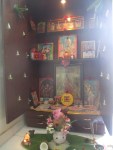
I bid a happy good bye to the fellow as I alighted from his rocking auto (not a comfortable ride really). My Puja already has a sealed copper urn of Ganga jal (holy water from river Ganga) sitting aside Zam Zam from Mecca that came from an Arab friend. Couldn’t refuse such a gift when it was offered without asking. I thought it was a sign and put it in my Puja. That must have been over ten years back. In spite of criticizing Islam and muslims and Christianity and christians, I cannot bring myself to show disrespect or disparity to Zam Zam treating it any different. I revere both the holy waters in my Puja. The Hindu in me would not allow anything less than that. In every cathedral I came across in Europe and Georgia, neither could I stop myself from saying a prayer to Christ. I asked for His pardon for deriding the faith that He founded. He must guess as to what drives passive Hindus like me to take on our adversaries headlong. Of course, I also asked Jesus to stop Vatican from converting Hindus and other natives forthwith!
Shall We Have A Greener Cleaner Hinduism?
 I originally blogged this in 2013, at least an year before BJP govt of Modi was sworn in after 2014 Lok Sabha elections, so this has nothing to do with current Sabarimala crisis. Reproduced with some ‘edits’
Let us get offended for right reasons. It’s not anyone’s prerogative to harm Mother Nature, and champions of the environmental cause are green warriors, not pseudo liberals.
***********************************************
An ardent Hindu, I am still not blind to how environmentally polluting our ways of worship are.
Everytime i light an oil lamp in my Pooja, i think of the billion homes lighting up the traditional diya all over India morning and evening just like me… and of our million temples lighting millions of lamps for their part….
I am worshiper of the sacred Diya myself – the lamp, the DEEP, the DIYA, the JYOTHI SWAROOP, that which dispels darkness which is supposed to be the manifestation of the very ‘light of knowledge’ we seek…
Still how many of us stop to think, how much we are heating up planet Earth with our religious practices that were perhaps once justified but may not be justifiable in present times… how many degrees we keep adding year after year to our annual average temperature without any second thoughts? India has definitely warmed up like never before in last two decades… to which how much exactly is our religious contribution any guess?
I know its next to impossible even for the rational me to stop lighting the ‘diya’ in my home – its unthinkable, inauspicious… Age old custom, its pretty tough to shake off this practice in a day, granted. So i can imagine how others around me must feel like on the issue… and as for our temples that light tens of thousands of lights every single day… what will happen to them without the ‘deep?’
Hinduism without the lit lamps is hard to imagine. The flame, the ‘jyothi’ is the light of our very own lives. Everything for us focuses on ‘light’ – the lamp. After all, our biggest national festival is ‘Diwali’ (Deepavali), the festival of lights. The lamps are our identity, like the bindhi (the dot) on our women’s forehead and the sari we drape… How to put off the lamp ever in this nation of ours without a whisper?
So when we have to rethink even about our oil diyas in my opinion, the question of chemical fire crackers does not even arise. A green Diwali and a cleaner chemical-free colourful Holi are the need of the hour. Immersion of painted Ganeshas (Ganesh Visarjan) and Kalis in our water bodies killing the marine life in the belt also has to be stopped forthwith. Is it anti-Hindu when we sound sane and logical.
One keeps hearing of Global Warming everywhere, especially in India. In my city, even the lower middle class homes can afford at least a single air-conditioner in harsh summers, so think of how much we are heating up planet earth every summer. Combined with the religious effect, think of the sum total warming up of our immediate ground atmosphere… (Not even taking into account the air pollution owing to vehicular traffic and fuel exhaust here).
So its ridiculous that year after year we must be complaining of erratic monsoons and melting glaciers and deficient rainfall, or in short Climate Change. Try explaining to our masses, the heat that must be generated by a billion lamps through out the country for years, for decades, for centuries and their effect on our environment … but this is one country where reasoning never works!

While i am kind of a believer in most of our rituals (i am not saying they are completely meaningless), which i understand have hidden contexts, I am increasingly concerned about the harm we are doing to our environment with our rituals. The rituals mean more to me for the Sanskrit mantras chanted which are supposed to have neuro linguistic and psycho linguistic benefits. Look at the Yagna here that is using up so much of precious potable water, a scarce product in many arid Indian states that might be reeling under drought wrought in by failed monsoons. (One may come up with argument about bath tubs at homes and hotels).
The Yagnas or the Homas. No Hindu marriage or housewarming or whatever is complete without this great Hindu religious ritual in which fire plays a major role. The holy fire I mean. In our wedding muhurat, the couples have to walk around the holy fire ‘Agni’ for seven times that will be alight for hours as sanskrit mantras are chanted in chorus by priests …. and for most of our ceremonies like death anniversaries, birthdays for children etc, again the homa fires in the homagunda will be lit for hours raising a big smoke… into which we pour everything from ghee (clarified butter), dried twigs, Nava Dhania (the nine food grains like pulses), flowers, fruits, even silk clothes, coins (gold if you can afford)…. because we believe giving the holy fire these things means our offerings will reach the Gods directly though the Agni medium which is one of the purest, and one of the five major natural elements of Earth (the other four being the air, the earth, the water, the sky)
Not denying i have participated in homams in my own family, but even the staunchest believer in me keeps questioning always why should so much be put to wastage by our religious practices. Isn’t there a different way? Can’t our Gods hear our prayers by any other means? Should our Gods have to be essentially bribed this way?!
One of our greatest temple rituals is ‘Abhishegam/Abhishek.’ This means bathing our ‘Murthis’ (idol or vigrahas) with water, curds, honey, milk, panchaamirtham (made out five fruits), etc after application of oil to the dieties. Imagine this done to all Hindu deities through out India in thousands and thousands of temples. After the ‘abhishek’ or’abhishegam’ is complete, we decorate our deities with floral garlands, silk clothes and gold and diamond jewelery. An ‘Archana‘ follows which means invoking the Lord’s and/or His Missus’ names 108 times or so with floral tributes. While i until today revel at the darshan of my Mother Goddess and Her Consort Shiva (and other gods and goddesses as the case may be) in their finest adornments in our temples, i can’t help wondering at all that which go waste in the name of these rituals…
Fortunately, a Hindu mind is trained in a way never to get carried over by superficial adornments of our deities that despite all the finery glittering in temples, we are still able to focus on the One Supreme – for in the bright ‘thejas’ face of the Lord and/or His Missus, we see infinite contentment, happiness, well being, prosperity, wisdom, health, all goodness of the world. So that’s one thing that eludes me completely…. that despite my skeptical views on temple rituals, i am unable to draw myself away from all this, that i am drawn like a bee to the nector when the abhishegam and archana are complete and when its moment for the ultimate ‘Darshan.’ …
I have stood in hour long queues for ‘darshans’ so who am I kidding. Yet i wonder, is this the way it is supposed to be, like whether we have reduced it all to one over-powering physical ‘darshan’ – a view of the reigning deity in all His/Her grandeur….
I wonder if its blasphemous to even write like this… but then i am a believer in a forgiving God always, a reasoning God and NEVER IN A PUNISHING GOD. One of the greatest advantages of being a Hindu is, you can be an atheist and still you are a Hindu! The very nature of Hinduism which is all encompassing, permits this!
Quote unquote :
…… No two paths need be alike …… that one is most a Hindu when one is least a Hindu. Hinduism’s propensity to absorb a multitude of thoughts including even atheism makes it, at times, inscrutable to its own followers….
I am not pro-Kumbh and it saddens me terribly to see how we mindlessly pollute the life-giving rivers of our land with our blind beliefs. Respect and reverence shown to our water sources is best illustrated with maintaining the water bodies clean and the water potable and useful for irrigation purposes for which they are meant. Rivers are our lifeline. Millenniums ago, perhaps we could afford the luxury of a Kumbh Mela, but can we in this 21st century wherein future wars are predicted to be fought over water?
I don’t want to add here how some north Indians dispose off their dead in the flowing Ganga. Its too distressing and gory. In our families mostly we cremate the dead. We have completely switched over to electric crematorium at least in cities these days which is a big relief. Even in our death, we seem to add smoke to our clear skies ….because in villages all over India, the dead of this billion strong nation are cremated with fresh wood cut from trees. The wealthier you are, the costlier is the wood for your pyre like the sandalwood.
Having blogged about my disgust on use of elephants in our temples only very recently, i wish to make the point once again:
https://vijiravindran.com/2017/02/12/stop-cruelty-to-elephants-in-the-name-of-religion-now/
Elephant habitat has shrunk drastically over years in India. When ‘Ashrams‘ spring up in elephant corridors we do not condemn them because we have the bargaining chip called Tourist Resorts. Finally, we shall wake up when the last Lord Ganesha will vanish for good from our Punya Bhoomi.
After all this i confess, i am a passionate Hindu at heart always….while i believe most of our rituals held some hidden meaning centuries back perhaps, time is now ripe for a revolution to redefine our beliefs in rituals. What is wrong with self-introspection?
I am for a Green & Eco-friendly Hinduism always if that can be made possible in my lifetime like a miracle somehow. I deliberately miss lighting my lamp twice a week atleast – my small contribution for a start to keep global warming a bit low. I wish we could be Eco-Friendly Hindus somehow.
There are many ways we south Indians are eco-friendly by culture. In our weddings, we still serve feasts on washed banana leaves and not on plates. The used banana leaves used to be fed to cows in the sheds in olden days. I am not sure how the used banana leaves are disposed off these days.
To a population that reveres nature so much with worshiping the flora of fauna of the universe, why is not there the realization on the flip side of this ancient culture?
Having said all this, would it be ever possible for me to go 100% green with my faith…. i do not want to lie, the transformation will be tough and testy but can be done step by step over a period of time. I wish i get encouragement from family and friends. I wish i could cut down on rituals boldly without being labelled an outcast and keep my faith at heart with just my prayer Mantras …. the Gods i believe in will be more than happier for the new believing me…
Convincing a billion Hindus around the world on the subject is another impossibility. How anyone should go about it is not clear, because like Christianity or Islam, the world’s oldest faith Hinduism does not have a religious book like the Bible or Quran, does not have a governing body like the Church or the Mosque and has no prophets or messengers from God like The Christ or Mohammad and no religious head like the Pope or the Maulvi….,,, Hindu Dharma is a way of life, way of life for over 6,000 years or perhaps older without all these elaborate set-up or disciplinary control… Sanatana Dharma has no founder, no founding date and is no man’s private or personal invention.
My earnest wish is that Hinduism evolves as it has been doing for centuries, for eons, to a greener way of life, less polluting Mother Earth, less harming Mother Nature. I appreciate the freedom my faith allows me to think rationally in all circumstances. At least, ‘a fatwa’ won’t be issued on my head, hopefully! I am today blogging like this because, Hinduism is still the most tolerant practice in the entire world, its all absorbent, most flexible, and grows with every merciless onslaught, much more powerful and stronger than ever before…
This is a country that celebrates vegetarianism where masses still worship ‘The Tulasi’ (basil) as a goddess, who marry the neem tree to the peepal tree who we think are like gods, who never slaughter the cows that walk on our highways, and who worship even inanimate objects like machine tools and musical instruments and books because they are creations anyway! I believe my tribe of like-minded Hindus is an ever-growing one.
LET’S NOT ALLOW HINDUISM TO BE TAKEN HOSTAGE BY EMPTY RITUALS THAT HAVE COME TO CONFINE OUR FAITH, ERODING ESSENTIAL SUBSTANCE OVER PERIOD OF TIME AND OBLITERATING THE TRUE ESSENCE OF DHARMA. HINDUISM IS FAR ABOVE AND MUCH MORE THAN ALL THAT – AN ENIGMA, A PHENOMENAL EXPERIENCE.
Let us allow Sanatana Dharma the vital lung space it deserves to evolve and flourish without our narrow, crooked-minded and low level of thinking.
JAI HIND!
 vijiravindran's