Posted in Books, Environment

Review: ‘The tusk that did the damage’ by Tania James.

I am re-blogging what I did in 2015 in yet another blog of mine. Poachers is the inspiration.

Book Review: ‘The Tusk That Did The Damage’ – by Tania James

August 29, 2015

ELEPHANT POACHING RESUMES IN KERALA/INDIA?

Felt a strange ‘deja vu’ reading this book. Read the excerpts in ‘The Hindu’ over an year back I guess. The synthetic achchan, Shakti mustard oil, sambar masala, the name Ravi Verma and then the mention of (some random) blogger and a few more could be the reason. Quickly checked out the first publication date: 2015 it says.

At the outset I believed the book was authored by an American American (!) I mean a caucasian so were surprised beyond limits that tusker names like Sooryamangalam Sreeganeshan must roll out so freely from the author’s imagination/research. This is possible only if you have an intimate knowledge and familiarity with the terrain and that kept playing at the back of my mind. The exact depiction of Kerala landscape, people, culture, toddy (!), elephants, wildlife parks everything was perfect. It was only when I was in the last 10 pages I cared to look up the author. Not a surprise that Tania James is an Indian American with roots in Kerala.

Aware of elephant torture in our temples, I still believed elephant poaching was rarest in India unlike it is in Africa where rampant hunting down of the species threatens the globe with their inevitable extinction in near future. Tampering/trespassing  with forest/wildlife reserve and/or any illegal encroachment is a serious criminal offence in the country.  I have observed from an NH project how even the highways are planned and mapped taking into due consideration the habitats of the native species and the flora & fauna of the land. The impression was, poaching stopped with the British barring one or two exceptional cases here  and there. Natives have captured stray elephants to train for battles, festivals in the past but rarely for tusks – or it was so believed.

A quick googling yielded the following links:

http://www.takepart.com/article/2012/10/09/indian-elephant-poaching

http://www.hindustantimes.com/india-news/elephant-poaching-haunts-kerala/article1-1366255.aspx

http://www.theguardian.com/environment/india-untamed/2015/aug/05/poachers-stalk-elephants-kerala-after-gap-of-20-years

http://savetheelephants.org/elephant-news-service/elephant-poaching-forest-officials-subvert-probe-india/

So almost after a clean dry period of 20 years, poaching has shockingly resumed in south Indian forests with forest officers hand in glove with poachers in the inhumane, dastardly act.

Indian elephants register casualty in unnatural circumstances owing chiefly to electrocution (by electric fences installed by industrious farmers) and rail accidents but elephants being poached in India in recent times is bothersome and shocking news. Elephant death statistics have recorded a zero to bare minimum under poaching so as not to make a headline. Until I read the book, I had assumed elephants were safe from poaching in India, with only our tigers having to live under the scare.  Single-horned Rhinos of Assam for another.

So the book has arrived just at appropriate time as a caution. A thorough investigation is mandatory in the poaching issue and offenders must be brought to book. Repeat offenders must be dealt with severely and if there does exist a network as alleged/illustrated in the book upto Dubai for tusks, the angle must be explored by all means.

The story is a moving narration, first person accounts of an innocent and aspiring young man, a woman film maker and the rogue elephant itself. Reminded of the tamil film ‘Kumki’ and to a certain extent couldn’t help wondering if the picture could have been a major influence with the book. Good sense of humour the author has interspersed through out the book. That helped in lightening up tense situations as the story was otherwise like one very serious affair.

My empathy is with Indian Elephants always- such a sad species. When the ‘gravedigger’ is made an orphan, it broke my heart. Every elephant killing is like driving a spear through my heart. To fell such a magnificent but a benign beast, one has to be a monster. Evil personified. Its not a matter of will power or skill. Its a matter of one’s heart. For what I hold for the Elephant is reverence, awe, affection. An elephant as we know generally is otherwise a gracious, gentle giant. Unless provoked, it never disturbs anyone.

I have had my share of jumbo safaris, elephants bathes but now regret it very much. Never imagined, how even the ritual bathing could be torturous to the animals. Someone tweeted: ‘Imagine yourself naked in a room and being fondled by a crowd of onlookers. This is how pet animals/zoo animals must feel.’ Ever since I am thinking  about even the zoos. Zoos are not pleasant places but they are the last refuge when it comes to conservation of rare species going extinct which can be bred in safety, away from poaching threats. And zoos have to be financially viable so opening them up for tours is necessary. How the human wave pressing from all over could be disturbing not only to the pachyderms but to all zoo animals. Yes, why should we wanna go near the tuskers? We can maintain a distance with them and enjoy from afar. When I did my elephant safaris twice, I kept caressing the elephant head, for the love of it. Its long hair almost 10 cm tall in the head was so prickly and thick. It was then I understood why people wear ‘ananudi’ (elephant hair) rings. I have seen them in jewelry shops in Chennai. Even the mahout (pappan) asked me if I wanted an elephant hair as souvenir and I was utterly taken back. Plucking one from the elephant must definitely cause it a lot of pain. I touched the old lady (in Elephant Park, Munnar), gave her fruits and asked her if she would remember me. Telling her I loved her was important then. In Thekady to our bewilderment, 3 of us were put over a single male elephant. The keeper said, elephants can bear weight, can carry logs. True, the young male did not even heave a heavy breath on carrying us triplet. The burden was no issue I guess.  But it did give us a guilty feeling. In Karnataka, limited myself to giving the elephant its bath in Kaveri. Recently from some Elephant Facebook pages I have been learning how Elephant Art (paintings by elephants), Elephant Safari everything is disguised and presented to tourists as acceptable/not inhuman. Good marketing by tourism industry with a keen business mind. In truth, even these are not appreciable. Wherever and whenever possible, the calves must be returned to where they belong – the wild. Elephants are not for our amusement.

Another thing, its irritating and again bothersome that wildlife must be so much photographed or filmed for someone’s thesis (for personal gains) or selling in the media (the telecast rights). Just how much revenue does our forest dept mint out of permitting foreign crews from recording the wildlife in their natural settings with their sophisticated equipment. Wildlife photography must be totally banned in India and elsewhere. Recall this from Night Safari in Singapore where we were warned not to shoot pictures in darkness out of concern for scaring the animals. But rigorous check was not carried out to see if anyone carried a camera. Some violated the rules and its true the night creatures panicked and scurried here & other when even the shots were captured in Night-vision mode. The purpose of night safari was lost.

Photography of trained/domesticated animals is okay perhaps. In Mudumalai wildlife sanctuary in Tamil Nad, we boarded a govt jeep that screeched in maximum decibels that no wonder none of us spotted anything in the park. But in the reserve shoulder adjoining the park, we luckily spotted a herd of wild elephants browned with mud bath. It was disturbing to see that even these were used to traffic noise and human scent that the herd tore the trees and munched away the shoots and branches without sparing us a glance as if they did not care who spotted them or clicked them.

I don’t feel good watching wild tiger pictures. That jeeps drive so close to them and that humans are no strangers to the big cats is distressing. For personal victories and gloating over Twitter and Facebook and Instagram, every dude with a DSL cam heads to our national wildlife parks & sanctuaries for shooting prize winning pictures that he/she thinks are his/her trophies. Why do we want audience for everything. I find the idea unsettling.

Treetop cottages in Wayanad (Kerala) and Topslip (Tamil Nad) are always in our mind. This is a quiet and undisturbing way to observe and enjoy wildlife. I guess most sanctuaries in India including Ranthambore etc offer this facility.

Top slip reminds me of a friend’s experience. You have to return with your jeep/car by 6 pm to base cottage there, for elephants will be on prowl in the wild with sunset. The friend’s family could not. They were near the summit when they came face to face with a herd of wild elephants. The head of the family switched off the lights and the engine, downed the windows just a fraction to let in breathing air as the family huddled closer to each other in the car. They were surrounded by 10-15 big bulls and cows and calves who were feeling all sides of the car with their trunks. The family held their breath and sat immobile, going to sleep without a sound as hours clicked, hostage to surrounding inquisitive wild elephants. Wouldn’t have taken the tuskers a minute to upturn the car. Finally only around the dawn the elephants left quietly and the badly scared guys made their u-turn. Next day they were warned by the forest dept for overstaying.

The so-called wildlife photographers, in my opinion, do much more damage to nature that they say they revere. Their pictures with tigers & elephants shall encourage a lot more travelers into the parks which is not desirable. This is one ground where I would not want awareness in our people. Lesser the footfall in the forest reserves/sancturies, the better.

The tribals living at the edge of forests face not only conversion threat (by evangelists) (!) but also find themselves mired at the centre of human-animal conflict. It’s a catch22 situation no doubt. The delicate balance existing between them who have lived with nature for generations and the precious wildlife has to be maintained at any cost. One more survey to carry out: conversion rates of native tribals by foreign sponsored NGOs & missionaries. Curious why the author has not made a point on that.

The author’s fiction, even if imaginary, serves what purpose. One more filming with light flashes amid fast disappearing wildlife, one more DVD, one more research grant – filling whose pockets, boosting whose egos, to whose advantage. What did the wildlife or even the tribals benefit from the outcome. Wonder if a single rupee would have gone towards the Indian elephant that the filmmaker (or perhaps the author) professes to care for. Raising awareness is a point. There is enough awareness without having to make fresh pictures, without having to venture a further kilometer within Indian forests or hovering around frightened captured young cows & calves in nurseries.

I did like the part about reunion of separated calves with their mothers. This has to be given impetus and the ingenious way of not touching the calves with human hands during rescue is good. Even those captured/nurtured by human hands finally seem to make it to the wild which is heartening. The way it must be.

Do we have statistical data on captured elephants/strays in India. Data on temple/church/mosque elephants. Because in Kerala, even churches and mosques use elephants for processions/celebrations. What is the exact figure of temple elephants in Kerala/Tamil Nad/Karnataka or generally in India/South India. What about private ownership, licencees. Why has not the forest department come out with a table on domesticated elephant population. Why not make the figures public.

The book did make an engrossing read only next to ‘The Elephant Song’ by Wilbur Smith. The characters, the dialogues, the setting everything was natural. Tragic was the death of Mani-Mathai and also that of Manu but then by now I have had enough of fictions that I know the twist always lies in ‘punishing’ the ‘promising’ ones that shall leave the reader with a kind of longing… More tragic is the fate of the Indian elephant…

Posted in Environment, Pictures Desi

Tele series: Poachers (Prime)

As a wildlife enthusiast and lover of the Indian elephant, I cannot thank enough the producers of Poachers (Amazon Prime), the mini series that highlights the poaching menace in Indian forest reserves. Slick and sharp, the episodes are to the point and cannot come crisper. Not a single minute of sag. Real life story. Before I proceed, all round applause to Nimisha Sajayan, who plays the Forest department cop attached to Kerala state. She is backed by a very well cast crew including the ones who play the roles of Neel Banerjee Kerala state wildlife director, and Alan, a part-time wildlife dept staff and IT person. Its heartwrenching watching this series, but is a must for wildlife lovers around the world. Following some elephant pages in social media, it was heartbreaking for me even recently to note the tragic poaching of three wild tuskers who towered to the skies, within the Amboseli national park range in Kenya, Africa. India is a natural elephant country so we know what it takes to have the wild elephants roam about our forest corridors. India without her elephants is unimaginable. I have covered quite a few reviews in my blog on wild life and especially on elephants/Indian elephants. Its no open secret that the ivory contraband smuggling goes hand in hand with underground mafia dealing in dope and/or arms. Its in national interest to see to that the nexus is thwarted. Funding terror can only be the next step away.

About Poachers, I have done this copy & paste job from Google:

The series is based on the real-life events of “Operation Shikar” that unfolded between 2015 and 2017, spearheaded by the Kerala Forest Department. Wildlife Trust of India (WTI) assisted in the investigations along with the police and others who risked their lives to unearth India’s largest poaching syndicate.


This article also may be of interest in this regard:

https://www.theweek.in/theweek/leisure/2024/03/02/the-real-story-behind-the-amazon-prime-series-poacher.html

My takeaway from the series is the knowledge that ivory is also used to make small trinkets to instill interest in (new) (fresh) buyers hoodwinking law enforcement in broad daylight. This may be done by honing/sharpening the tusks of the temple elephants or elephants in captivity. Such a pruning of the domesticated elephant tusks may yield just enough shavings to cater to small buyers. There must be artisans devoted to the crafting art with the promise of a small/discreet market. Ultimately this may lead to sustained interest and big buyers who may be collectors of the exotic. So the only way to stop the tusk pruning of the tamed elephants is that, they may have to be let loose in the wild. NO MORE TEMPLE ELEPHANTS, NO MORE ELEPHANTS IN CAPCIVITY, NO MORE ELEPHANTS FOR ENTERTAINMENT INDUSTRY. Destroy the ivory as and when found. China, needless to say, is the first and worst international ivory market. When buyers create a demand, a supply chain can possibly be established especially in weaker territories. Its one tough job out there for our forest department officials.

It was shocking to note that the big Ambani pre-wedding party had a prop of an elephant – drumbeating about the virtues of Vantara at the same time. How hypocritic. Vantara will be zilch investment luxury forest safari lodge for the who-is-who of India, no more. Very clever Ambani marketing. Looks like they took over 200 ailing elephants for the project from all across India. Anyone who loves wildlife, will never do this:

Posted in Environment

Under Threat: Bitra: Floating Marine Reserve, India.

Ref: How the Bitra Floating Marine Reserve was born – by Rohan Arthur and T R Shankar Raman , from ‘At the feet of living things’ -edited by Aparajitta Datta

Always amazed by fish spawning frenzy spotlighted by underwater videos that we come across in Animal Planet etc. Never knew it had a scientific name: FSA (Fish Spawning aggregation). What is more surprising is learning that India has a Floating Marine Reserve (among a handful) at Bitra, Lakshadweep group of Islands falling under the Union Territory, off Kerala coast, in the Arabian sea.

Some of the books I have read on the wildlife in India were authored by wildlife research aspirants who were gathering material and evidence for their doctorate. The Bitra Reserve apparently was born thanks to the efforts of two such ambitious and enthusiastic PhD candidates of Fisheries who had chosen Bitra for their studies. I am blogging this from a series of essays on Indian wildlife conservation efforts in about a quarter century until the 1990s. Some articles lie outside the purview of the scope of the book obviously, because the Bitra scene is from very recent. One of the group of islands of the Lakshadweep archipelago, Bitra is an impoverished fishing island where naturally fishing continues to be the way of life. The two researchers Rohan Arthur and T S Shankar Raman venture into this sleepy fishing center and stumble upon the FSA off the reefs of Bitra sea. They discover in the year close to 2012 that there is the FSA (fish spawning aggregation) ritual happening under sea near the reef where the square tails aggregated in tens of thousands to spawn their litter. A rare event in Indian territory, the Fisheries guys congregate with the locals and take steps to preserve the FSA from damages of fishing.

Seriously I wish they hadn’t tabled their findings! In a bid to submit their papers for their diplomas, they have given away the precious info to the locals that they seem to exploit for commercial gains. The earliest boost for their venture was the kudos that came from the Fisheries department itself that went against their grain. The department seconding to save fish is anathema to their founding principles and motto. No wonder, the plans fell flat in their face as the local fishermen refused to comply with the restrictions and started fishing vigorously in the delicately balanced marine eco system with the mother boats that made a killing catch every season of spawning (around new moon day a particular time of the year). Thus in matter of ten years the FSA fish count has dropped by over 90% . Human greed knows no bounds. Educating the local fishermen, bringing the awareness is a slow process but can work in the long run. Hopefully by the time realization dawns, there are still square tails left out in the Arabian sea/Indian ocean to make it to the Bitra reef for their annual appointed FSA.

Will the center look in and do something decisive about the protection of the Bitra reef and FSA therein? #narendramodi

I am banking on our Prime Minister Shri Narendra Modi ji on saving the floating marine reserve at Bitra and the annual FSA, saving the square tail and other fish species from extinction in near future. FSA is way of nature. We shall be making or breaking the natural cycle in Bitra shortly as frenzied fishing activity near the reef can drive the fish away from the FSA pool which for some evolutionary/geographic/scientific reason has been natural selection for the fish species since ages.

Posted in Political

The Invisible Foreign Hand: Conversions

The Breaking India Forces At Work In North East

This is merely the tip of the iceberg: in continuation of posts on the scourge of Conversion in India. Limiting the scope here to North East and Kerala.

The British did not decamp in entirety from India in 1947, with the Christian missionaries in the country opting to stay put spreading the gospel. Pandit Jawaharlal Nehru’s Congress government apparently had no issues on that. Prime minister Nehru, with his communist Defence minister and cabinet ally V R Krishna Menon who could be singly held responsible for Sin0-Indian war of 1962, was bent on projecting the secular face of India at the expense of conversion of vast majority of North East Indians to Christianity, in miraculous span of a couple of decades. The  Christian missionaries who were by this time deeply entrenched in the hilly tracts of the east Himalayan states, did not stop with their evangelical work in sovereign Indian soil. They were also actively engaged on the other hand in abetting openly the Nagas to seek their independence from the newly constituted Indian union on the basis of religion to whose ’cause’ the British government claimed to be ‘sympathetic.’ The economic and military support that armed the Nagas to the teeth must have misguided the Nagas. It is no surprise that the British when they left India also generously offered similar ‘friendly pacts’ to small Hindu princes whose kingdoms were unilaterally fused with the union of India, by the sheer will of Sardar Vallabhbhai Patel, the Home Minister and Deputy PM. Kashmir is a case in point. Kashmir would not have gone to the United Nations if not for India’s last serving British Governor General, Mount Batten. Lessons learned from Kashmir probably helped India when it came to dealing with Nagaland. British journalists were writing of the ‘Naga plight’ in their national dailies (among other concerns of theirs about India whose survival was predicted not beyond ‘five years’ by none other than prime minister Winston Churchill.) The British government no doubt underestimated the newly resurgent independent India, advising the young Indian nation to ‘let go of the Naga.’ Phizo, the chief rebel Naga leader of NNC (Naga National Council) was granted political asylum in Britain. Ever since, Nagaland has been a thorn in our flesh, with our tribal brethren alienated from us on widespread conversion, wanting to sever ties with the Indian republic. Nagas have exercised their adult franchise in the past with rest of India, yet the divisive lines have always been left open like festering wounds.

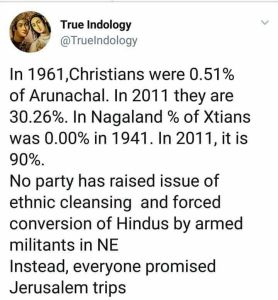
This tweet gives one a picture of the level of Christian conversion taking place in Nagaland from before 1947 and how it went unchecked for decades after independence, with foreign missionaries pumping in NGO funding and extending moral support.

Once a majority of populace in any state in India is converted to non-Hindu/non Indic such as Abrahamic with Middle Eastern origin, it may be possible to entrap/enroll them in larger schemes such as ‘Breaking India’ missions. Nagaland could never have been independent but would have been absorbed by China. Kashmir can never been independent. Its strategic location would make it the next Afghanistan in no time (if not for India). The buffer states of Kashmir and North East India do not only function as shock absorbers securing and safe-guarding the rest of India, but are also preventing themselves from turning into next casualty, on the strength derived from Force India.

Nagaland geography is another critical point. Sandwiched between China and East Pakistan (now Bangladesh), Nagaland and the even the rest of the north-east, is a security issue for India. The unsolved Naga equation has been an irritant for Indian nation for long. The entire North East India is a sensitive strip.

One cannot help quoting in this context, the UK’s war with Argentina at the start of the 1980s, for Falkland Islands which must legitimately belong to the South American nation. The havoc the British have wrecked in their erstwhile colonies leaving loopholes deliberately unplugged with an intent to cause trouble at a future date, is now coming to surface as evident in Sri Lanka, Malaysia etc where (violent) communal strifes have erupted in recent years. The Englishman played one ethnic group against another before going back home for good. Legacy of the British policy of ‘Divide and Rule.’

The BJP win in Nagaland raises hope. The Nagas have finally come home. It may not be too late either to correct the injustices and mistakes committed by the Congress government for 60 long years in the Seven-Sister-States of India. A ‘Gharwapsi’ is our legitimate right. A reversal of the conditions back to pre-missionary era should hardly raise the liberals’ eyebrows.

The BJP sweep in North East leaves Kerala as the single and only remaining Communist state of India. The 20+ years of Communist regime in the state of Tripura has been brought to a close.

Like the North Eastern India, Kerala too is victim to calculated and widespread conversion (to Christianity).

In the case of Kerala, I am to deal with a peculiar issue here that hardly draws the attention of our government or agencies that it deserves.

I have been been following a few Elephant care groups in the social media Facebook. The unnatural, abnormal concern  of foreign nationals for the Indian elephants sparked my interest. It is with utmost certainty that I can vouch that, one hundred percent all the Elephant care groups in India are Evangelical missions sponsored by foreign church. To mention a case in point: Kerala Suffering Elephants. A quick browsing of the group’s content and members will reveal the vested interest of these foreign Christian evangelists/missionaries strangely in Indian elephants that are employed in service of Kerala Hindu temples (for centuries now as part of local custom and traditions). Now the domesticated elephants in Kerala are not restricted to Hindu temples; Churches and Mosques too use elephants for their festivals, however one finds no mention of Elephants maltreated and misused in non-Hindu places of worship.

The Christian missionaries in India are starting to feel the pinch, as the Modi government has successfully blocked the funding of hundreds of fake NGOs who were dubiously funding conversions in India. Kerala Communist government turns a blind eye to the shocking horror and reality unfolding in the state which could have a drastic impact on the future of the state which was overwhelmingly Hindu even at the time of our independence. Today, the Hindus of the state have been reduced to a minority due to flawed communist policies giving a free hand to overseas missions to carry out uncontrolled and unregulated conversions.

With one after  the other most avenues of funding closed, it is easy guess that the evangelists both local and foreign are targeting the Hindu temples using the Indian Elephants as their front. I am an Elephant lover myself. However it is not difficult for me to blow the cloak of the evangelist missions who are trying to wage a war on India on a different and altogether unbelievable front.

While the concern for the endangered species is appreciated, is it not ironic that almost all the foreign members of the Kerala Elephant  groups happen to have church connections. In a recent post in one more Elephant care group based in Africa, it was revealed how some fake Facebook groups in Europe and USA were duping the gullible, inviting them to fund Elephant conservation.

The multi-pronged threats faced by India from every direction one can think of, is alarming. The missionaries are clearly cooling their heels waiting for the return of the Congress government which will undoubtedly give them a free run with funding for conversion in the country. Unabated conversions were happening until the BJP formed the government. Even as of today, illegal conversions are taking place in every state of India including Tamil Nadu. The last time I visited home, I was shocked to learn two of my friends’ maids had been bribed to conversion by ‘Aseervadham’ church in Anna Nagar, Chennai. In Pulla Avenue, I was witness to evangelists going shop to shop offering bribes for conversions to petty shop owners and pavement stall holders.

This when they talk about the Saffron surge and VHP and Shiv Sena and RSS and Hindutva. Right under the nose of Bharatiya Janata Party.