Posted in Environment

Sea Grass Meadows: the Carbon Capturers of the Oceans.

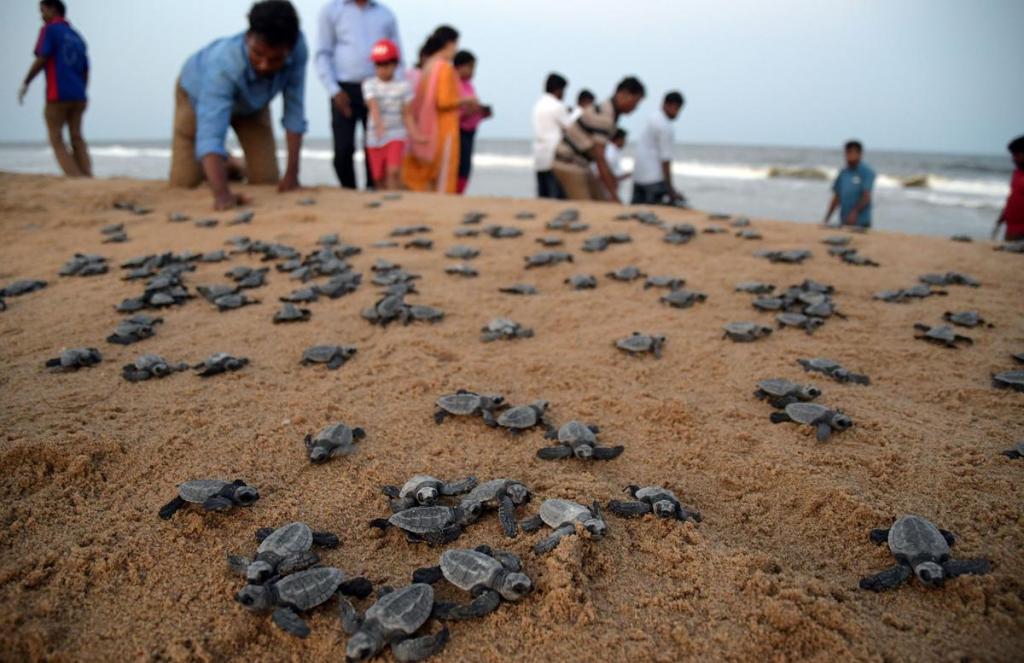
In Palavakkam, a suburb of Chennai, the stretch of beach sees Olive Ridleys laying eggs in the shore. To encourage the turtle breeding and to not confuse the hatchlings with too much illumination in the darkness of the night, the street lights are strictly switched off. This ensures that the turtle hatchlings make their way to the sea in their still unsteady tiny feat. The neighbourhood volunteer self-styled environmentalists help the stranded ones reach the waters safe. Olive Ridleys breed through stretches of the eastern Coromandel coast of India. The state pf Orissa is another popular pick for them with its pristine virgin beaches with minimum recorded human footfall. As awareness kicks in, locals now make sure that the olive ridley hatchlings survive. And therefore the south east coast of India remains the olive ridleys’ favourite destination when it comes to breeding. To encourage the adult female turtles to lay their eggs in the beach sand, the switching off of street lights is encouraged and practised. This shows that we are a responsible society willing to go the extra mile to see that wildlife is nurtured. Conflicts arise mostly when there is damage to property and/or loss of human life as it happens in the elephant corridors where human settlements bifurcate forest reserves.

Anyway, that is how my interest in olive ridleys happened. For sighting, one can plan an outing. This extraordinary adventure is open for city dwellers without pinching their pockets.
https://timesofindia.indiatimes.com/videos/news/chennai-baby-olive-ridley-turtles-emerge-from-pits-crawl-into-sea/videoshow/58098913.cms?from=mdr

It sounds implausible that the cousins of Olive Ridleys, the Green Turtles must be behind the environmental destruction caused by disappearing seagrass meadows with their mass feeding frenzy?! It comes as a shocking surprise that sometimes specific wild flora and fauna may turn out to be the agents behind driving to extinction many other co-existent wild species vying for survival in the same shared environment or eco-system. Of course, if wheat and paddy are widely cultivated and thriving crop species today, once upon a time they must have been the weed that drove to extinction better cereals/food grains. Like the poultry and cattle, maize and wheat are winners by mere mindless propagation. Green turtles to me sound like these hollow winners of the ecological war. Besides, it is news to me that the seagrass can capture and block at least eighteen percent of global carbon. It means the seagrass may be having a direct and significant role in oxygen quality in planet earth. Precisely this seagrass is fodder for dugongs, green turtles and other sea creature that mostly graze them to extinction. Reading of the green turtles in swarms feeding on the leaves and then even digging out the roots of the sea grass, one is reminded of the human greed. Green turtles have no geographic home ground. They are on the move for the entire span of their lives moving enmasse from one atoll to another, in search of seagrass, their staple food. They circumnavigate the earth thus from Cuba to Indonesia, India to Maldives and Pacific islands. In India, for a while, the Lakshadweep lagoons served as their feeding grounds before they grazed them seagrass meadows to near extinction. And then they were gone. Refer/recommend the book ‘At the feet of the living things’ yet again, authored by research scholars backed by NCF Aparajitha Dutta and others.

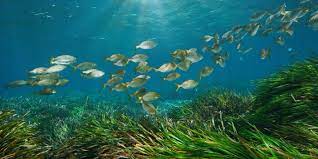
Seagrass meadows, the savannahs of the ocean are also the ecosystems that sustain a plethora of fish families besides supporting the turtles, dugongs and the like. Correlated to the corals and the mangroves, the seagrass meadows play a vital role in sustaining living organisms in the planet. Kudos to research scholars and NCF, India for coming up with unconventional ideas to protect and propagate sea grass and thus saving it from total extinction in this part of the world.

Mother nature maintains a delicate balance: the green turtles have to survive and the seagrass meadows also must flourish giving earth a chance to breathe. The key to Planet Earth’s survival lies under the oceans: in the profusion of seagrass meadows that absorb the excess carbon from the atmosphere and keep it all locked down fathoms beneath them cleaning up the oceans.

Wow now I do wanna go for snorkelling! I didn’t capitalize on a dozen chances I got in life, out of … er.. kind of phobia 😀 but then what a terrible loss this is. I must, the next time opportunity presents itself.

Posted in Environment

Ganesh Visarjan in Tamil Nadu is imported culture from Mumbai from ’90s.

Our Ganesh Visarjan in the 1970s and 80s was always on third day or fifth day after Ganesh Chaturthi at either Kapaleeshwar temple tank or Chitrakulam temple tank in Mylapore. This is how we bid goodbye to the Elephant god traditionally as we did not have a deep well at home to drop Him in. I remember the rare times we took Him to the marina to immerse Him in the sea. The visarjan was a very private thing or family affair. I don’t think we clubbed the occasion with anyone or anything. No big fuss about it. Mostly my father would carry the Ganesha a bit unceremoniously in a bucket bag to leave Him in the steps of Kapali temple tank or if they permitted, immerse Him with his own hands in the tank water. Locals always favoured the nearest temple tank for the visarjan.

Even after I married, in my in-laws home, we always dropped our Ganesha in our house well that was in the backyard.

This is how for decades we celebrated Vinayak Chaturthi in Chennai or perhaps in entire Tamil Nadu. NO STREET PANDALS. NO TRAFFIC BLOCKS. NO LOUDSPEAKER BLARE. NO MAMMOTH COLOURFUL PLASTER-OF-PARIS GANESHAS, NO PROCESSIONS, NO CROWD, NO POLLUTION, NO DONATIONS but truly in the spirit of the festival the way it must be. Such a homely one in my memory.

Come the festival season, our guys are upto it again. They kick up a storm that the government is preventing Hindus from celebrating Ganesh chaturthi that has always been celebrated with such a fanfare in the state. Excuse me, just who are you kidding??? Not even a single colour coated Ganesh in the city up until at least 1992-93. It is after 1995 or from an year or two before that the Ganesha pandal culture established itself in Tamil Nadu. And now we are going gungho about it as if we were always born and bred in this Ganpati Bappa Moriya milieu. Just what is our problem. Why do we want to invent more crowded gala events as if our calendar is not full as such? Who do we want to bait?

Are the literate in the state even aware of what a pollution the visarjan in the sea of the coloured Ganeshas made of plastic and plaster-of-paris is causing already. The marine life is facing the brunt and the entire fragile marine ecology is on the verge of a collapse as year by year the debris keeps mounting. The natural surroundings in the coastline suffer damage and it is not unusual to spot dead fish litter in the beach for days after the visarjan. The olive riddley turtles approach the coromandel east coast for nesting during their breeding season. What a havoc the visarjan can wreck to their reproduction cycle.

What kind of blind faith is this. What kind of sick ritual is this. It is time we stop this nonsense that is now degenerating into mob hysteria and a law and order problem . Years back our Ganeshas were made of clay and they left no negative impact on our environment. A few Ganeshas nowadays are eco-friendly. Like we have even the seed Ganesha pumped in with specific plant seeds when on immersion in a local water body or soil or just in a house plant pot can help germinate the seeds and sprout young saplings. However this percentage of eco-friendly Ganeshes could be far less than 0.01 percent. The majority that have insolvable components made of toxic material end up in our ocean waters, destroying marine life, polluting the coastal sea shelf, rendering irreparable damage to our ocean resources.

India has a very weak and poor sewerage treatment record as such. We are complicating matters for ourselves, nothing more. We only have to compare the fish size in India with that in foreign port cities. In the navigable waters of India, for instance, the maximum size a Red snapper (Sultan basi in arab and sankara in tamil) can grow into is seven to eight inches. I am seeing dining plate diameter size (twelve inches) red snappers caught from middle east coast line here. It means, India’s fish are getting smaller and smaller in size. Is it dwarfing? Or is it that we are not allowing our fish to live their full lifecycle. Are we netting our fish before they can reproduce. Or is our marine pollution affecting our fish breeding and population.

Every single Hindu has to ask this question to his/her heart. What are we doing to our motherland in the name of Dharma? Separating baby calves from wild elephant herds, their mothers and torturing them in our temples. Polluting in the name of Ganesha our seas and land apart from the noise pollution we generate. Such a plastic glut. Clutter that is not organic. The waste we generate in our festivals, a good majority of it, will not decompose. Neither are they recyclable. So where do they end up? In the bottom of our ocean floors, where else.

Ganesha must be regretting the Vinayaka chaturthi festival. Why can’t we give Him just modak and lots of our love and be at peace. We can still have the earthen Ganeshas and take him to the sea individually at our ease, as and when we can, like we used to until the imported pandal culture made things worse. In all this melee, where is a moment to think of Ganesha.

Now wonder, who is anti-Hindu.