Posted in Books, Environment

Review: ‘The tusk that did the damage’ by Tania James.

I am re-blogging what I did in 2015 in yet another blog of mine. Poachers is the inspiration.

Book Review: ‘The Tusk That Did The Damage’ – by Tania James

August 29, 2015

ELEPHANT POACHING RESUMES IN KERALA/INDIA?

Felt a strange ‘deja vu’ reading this book. Read the excerpts in ‘The Hindu’ over an year back I guess. The synthetic achchan, Shakti mustard oil, sambar masala, the name Ravi Verma and then the mention of (some random) blogger and a few more could be the reason. Quickly checked out the first publication date: 2015 it says.

At the outset I believed the book was authored by an American American (!) I mean a caucasian so were surprised beyond limits that tusker names like Sooryamangalam Sreeganeshan must roll out so freely from the author’s imagination/research. This is possible only if you have an intimate knowledge and familiarity with the terrain and that kept playing at the back of my mind. The exact depiction of Kerala landscape, people, culture, toddy (!), elephants, wildlife parks everything was perfect. It was only when I was in the last 10 pages I cared to look up the author. Not a surprise that Tania James is an Indian American with roots in Kerala.

Aware of elephant torture in our temples, I still believed elephant poaching was rarest in India unlike it is in Africa where rampant hunting down of the species threatens the globe with their inevitable extinction in near future. Tampering/trespassing  with forest/wildlife reserve and/or any illegal encroachment is a serious criminal offence in the country.  I have observed from an NH project how even the highways are planned and mapped taking into due consideration the habitats of the native species and the flora & fauna of the land. The impression was, poaching stopped with the British barring one or two exceptional cases here  and there. Natives have captured stray elephants to train for battles, festivals in the past but rarely for tusks – or it was so believed.

A quick googling yielded the following links:

http://www.takepart.com/article/2012/10/09/indian-elephant-poaching

http://www.hindustantimes.com/india-news/elephant-poaching-haunts-kerala/article1-1366255.aspx

http://www.theguardian.com/environment/india-untamed/2015/aug/05/poachers-stalk-elephants-kerala-after-gap-of-20-years

http://savetheelephants.org/elephant-news-service/elephant-poaching-forest-officials-subvert-probe-india/

So almost after a clean dry period of 20 years, poaching has shockingly resumed in south Indian forests with forest officers hand in glove with poachers in the inhumane, dastardly act.

Indian elephants register casualty in unnatural circumstances owing chiefly to electrocution (by electric fences installed by industrious farmers) and rail accidents but elephants being poached in India in recent times is bothersome and shocking news. Elephant death statistics have recorded a zero to bare minimum under poaching so as not to make a headline. Until I read the book, I had assumed elephants were safe from poaching in India, with only our tigers having to live under the scare.  Single-horned Rhinos of Assam for another.

So the book has arrived just at appropriate time as a caution. A thorough investigation is mandatory in the poaching issue and offenders must be brought to book. Repeat offenders must be dealt with severely and if there does exist a network as alleged/illustrated in the book upto Dubai for tusks, the angle must be explored by all means.

The story is a moving narration, first person accounts of an innocent and aspiring young man, a woman film maker and the rogue elephant itself. Reminded of the tamil film ‘Kumki’ and to a certain extent couldn’t help wondering if the picture could have been a major influence with the book. Good sense of humour the author has interspersed through out the book. That helped in lightening up tense situations as the story was otherwise like one very serious affair.

My empathy is with Indian Elephants always- such a sad species. When the ‘gravedigger’ is made an orphan, it broke my heart. Every elephant killing is like driving a spear through my heart. To fell such a magnificent but a benign beast, one has to be a monster. Evil personified. Its not a matter of will power or skill. Its a matter of one’s heart. For what I hold for the Elephant is reverence, awe, affection. An elephant as we know generally is otherwise a gracious, gentle giant. Unless provoked, it never disturbs anyone.

I have had my share of jumbo safaris, elephants bathes but now regret it very much. Never imagined, how even the ritual bathing could be torturous to the animals. Someone tweeted: ‘Imagine yourself naked in a room and being fondled by a crowd of onlookers. This is how pet animals/zoo animals must feel.’ Ever since I am thinking  about even the zoos. Zoos are not pleasant places but they are the last refuge when it comes to conservation of rare species going extinct which can be bred in safety, away from poaching threats. And zoos have to be financially viable so opening them up for tours is necessary. How the human wave pressing from all over could be disturbing not only to the pachyderms but to all zoo animals. Yes, why should we wanna go near the tuskers? We can maintain a distance with them and enjoy from afar. When I did my elephant safaris twice, I kept caressing the elephant head, for the love of it. Its long hair almost 10 cm tall in the head was so prickly and thick. It was then I understood why people wear ‘ananudi’ (elephant hair) rings. I have seen them in jewelry shops in Chennai. Even the mahout (pappan) asked me if I wanted an elephant hair as souvenir and I was utterly taken back. Plucking one from the elephant must definitely cause it a lot of pain. I touched the old lady (in Elephant Park, Munnar), gave her fruits and asked her if she would remember me. Telling her I loved her was important then. In Thekady to our bewilderment, 3 of us were put over a single male elephant. The keeper said, elephants can bear weight, can carry logs. True, the young male did not even heave a heavy breath on carrying us triplet. The burden was no issue I guess.  But it did give us a guilty feeling. In Karnataka, limited myself to giving the elephant its bath in Kaveri. Recently from some Elephant Facebook pages I have been learning how Elephant Art (paintings by elephants), Elephant Safari everything is disguised and presented to tourists as acceptable/not inhuman. Good marketing by tourism industry with a keen business mind. In truth, even these are not appreciable. Wherever and whenever possible, the calves must be returned to where they belong – the wild. Elephants are not for our amusement.

Another thing, its irritating and again bothersome that wildlife must be so much photographed or filmed for someone’s thesis (for personal gains) or selling in the media (the telecast rights). Just how much revenue does our forest dept mint out of permitting foreign crews from recording the wildlife in their natural settings with their sophisticated equipment. Wildlife photography must be totally banned in India and elsewhere. Recall this from Night Safari in Singapore where we were warned not to shoot pictures in darkness out of concern for scaring the animals. But rigorous check was not carried out to see if anyone carried a camera. Some violated the rules and its true the night creatures panicked and scurried here & other when even the shots were captured in Night-vision mode. The purpose of night safari was lost.

Photography of trained/domesticated animals is okay perhaps. In Mudumalai wildlife sanctuary in Tamil Nad, we boarded a govt jeep that screeched in maximum decibels that no wonder none of us spotted anything in the park. But in the reserve shoulder adjoining the park, we luckily spotted a herd of wild elephants browned with mud bath. It was disturbing to see that even these were used to traffic noise and human scent that the herd tore the trees and munched away the shoots and branches without sparing us a glance as if they did not care who spotted them or clicked them.

I don’t feel good watching wild tiger pictures. That jeeps drive so close to them and that humans are no strangers to the big cats is distressing. For personal victories and gloating over Twitter and Facebook and Instagram, every dude with a DSL cam heads to our national wildlife parks & sanctuaries for shooting prize winning pictures that he/she thinks are his/her trophies. Why do we want audience for everything. I find the idea unsettling.

Treetop cottages in Wayanad (Kerala) and Topslip (Tamil Nad) are always in our mind. This is a quiet and undisturbing way to observe and enjoy wildlife. I guess most sanctuaries in India including Ranthambore etc offer this facility.

Top slip reminds me of a friend’s experience. You have to return with your jeep/car by 6 pm to base cottage there, for elephants will be on prowl in the wild with sunset. The friend’s family could not. They were near the summit when they came face to face with a herd of wild elephants. The head of the family switched off the lights and the engine, downed the windows just a fraction to let in breathing air as the family huddled closer to each other in the car. They were surrounded by 10-15 big bulls and cows and calves who were feeling all sides of the car with their trunks. The family held their breath and sat immobile, going to sleep without a sound as hours clicked, hostage to surrounding inquisitive wild elephants. Wouldn’t have taken the tuskers a minute to upturn the car. Finally only around the dawn the elephants left quietly and the badly scared guys made their u-turn. Next day they were warned by the forest dept for overstaying.

The so-called wildlife photographers, in my opinion, do much more damage to nature that they say they revere. Their pictures with tigers & elephants shall encourage a lot more travelers into the parks which is not desirable. This is one ground where I would not want awareness in our people. Lesser the footfall in the forest reserves/sancturies, the better.

The tribals living at the edge of forests face not only conversion threat (by evangelists) (!) but also find themselves mired at the centre of human-animal conflict. It’s a catch22 situation no doubt. The delicate balance existing between them who have lived with nature for generations and the precious wildlife has to be maintained at any cost. One more survey to carry out: conversion rates of native tribals by foreign sponsored NGOs & missionaries. Curious why the author has not made a point on that.

The author’s fiction, even if imaginary, serves what purpose. One more filming with light flashes amid fast disappearing wildlife, one more DVD, one more research grant – filling whose pockets, boosting whose egos, to whose advantage. What did the wildlife or even the tribals benefit from the outcome. Wonder if a single rupee would have gone towards the Indian elephant that the filmmaker (or perhaps the author) professes to care for. Raising awareness is a point. There is enough awareness without having to make fresh pictures, without having to venture a further kilometer within Indian forests or hovering around frightened captured young cows & calves in nurseries.

I did like the part about reunion of separated calves with their mothers. This has to be given impetus and the ingenious way of not touching the calves with human hands during rescue is good. Even those captured/nurtured by human hands finally seem to make it to the wild which is heartening. The way it must be.

Do we have statistical data on captured elephants/strays in India. Data on temple/church/mosque elephants. Because in Kerala, even churches and mosques use elephants for processions/celebrations. What is the exact figure of temple elephants in Kerala/Tamil Nad/Karnataka or generally in India/South India. What about private ownership, licencees. Why has not the forest department come out with a table on domesticated elephant population. Why not make the figures public.

The book did make an engrossing read only next to ‘The Elephant Song’ by Wilbur Smith. The characters, the dialogues, the setting everything was natural. Tragic was the death of Mani-Mathai and also that of Manu but then by now I have had enough of fictions that I know the twist always lies in ‘punishing’ the ‘promising’ ones that shall leave the reader with a kind of longing… More tragic is the fate of the Indian elephant…
Posted in Environment, Socio-Cultural

Stop Cruelty To Elephants In The Name Of Religion NOW !!!

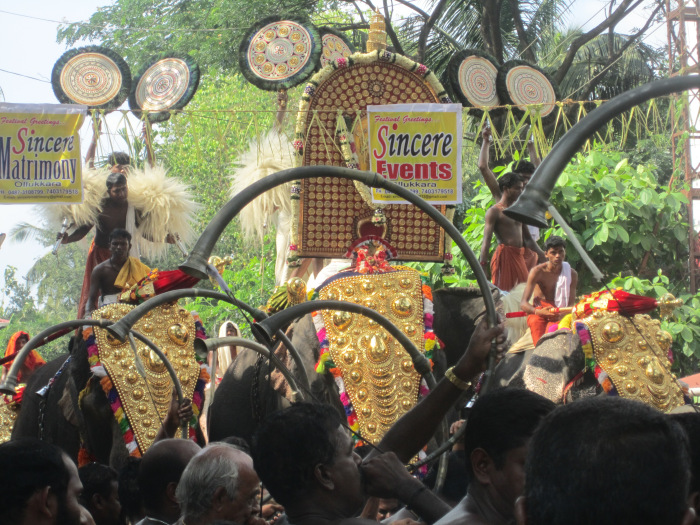
some 5 elephants, 3 in the front row and 2 behind for Sri Bhagawati temple vela (pooram), cherukulangara, Thrissur – day March 28, 2013

(Originally published the 7th of April, 2013 in a private blog . Edited and Reblogged )

I have always been awed by the Pooram festivals of Kerala, my neighbouring state. The most famous one that attracts hordes of both local and foreign tourists is the Pooram Festival of Shri Vadakkunathan Temple in the town of Thrissur. This mega temple festival that falls in the end of the month of March stars over a dozen elephants parading the Temple Deities in hot, merciless summer sun of India to the loudest blares of ‘Pancha Vaadhyam’ – the five traditional desi musical instruments comprising drums and trumpets.

A devout Hindu, i am at loss to comprehend the logic behind this heartless, mindless cruelty inflicted upon these most beautiful and wisest beasts on face of earth, the elephants, in the name of religion.

Imagine what could happen to jumbos trotting barefoot in intense heatwave of over 40 C (over 100 F) with capstans weighing in tonnes on their breaking back, in front of tens of thousands of frenzied crowds to the ear-splitting thumping of the Pancha Vadhyam, with firecrackers bursting nonstop through the celebrations? Won’t the elephants feel claustrophobic in the first place for their size, away from their natural wild habitat?

During one of my trips to Kerala, I could attend the Pooram festival of a very small and beautiful temple in Thrissur – the Bhagwati temple of Cherukulangara.  Even in this small event, some five elephants partook in the festivities.  March was closing with April starting, and already the mercury was rising rather menacingly.

In the evening came the rudest shock: I was in the temple where in the backyards i saw the five elephants with feet chained loosely (the elephants i must admit looked healthy, well fed (which was a small consolation) and were not chained stiff; they could still amble about and i was relieved they did not look alarmed or disturbed. While Shakthi and Shiva are who I look upon like my beloved, respectful and benevolent parents, I wonder whether the same Mother Goddess of mine and the Father would approve of such inhumane torture and cruelty meted out to defenceless elephants in the name of religion in their holy abode.What is this other than man-invented frivolous ritual? )  The elephants were quietly feeding on leaves and fruits and seemed relaxed that somewhat pacified me. Given the hysteric beating of drums and the creaking of loudspeakers in highest decibels, i was slightly agitated. After all it was my first ever LIVE Pooram!   (In Bhagwati temples (Devi temples), Pooram is referred to as ‘Vela.’)

Elephants are mammoth species that subsist on vast swathes of moving space. That is how nature makes them as well as any other wild life: nomadic and free-spirited. How claustrophobic the gentle giants must feel within the confined spaces and congested quarters with granite flooring and barred ventilation, having been ‘tamed’ and ‘taught to obey’ with the ‘tanda’ (stick)?

http://www.thehindu.com/todays-paper/tp-national/tp-tamilnadu/heartrending-scenes-mark-burial-of-temple-elephant/article2647127.ece

The time was around 7 pm in the evening and then started the fireworks.  My  heart skipped a beat but maintaining a cautious distance from the elephants I still fixed my gaze on them to check if they were okay.  Thank God a million, the elephants seemed disinterested in the noise, the sound, the fanfare and continued feeding, unperturbed by the 500 wala and the 1000 wala crackers lighting up the skies for the next 1 hour or so.  I went back to my friend’s house in haste and even from a distance of 1 km could hear the bursting of the crackers.

That night my friend, a native of Thrissur, and I were talking of the fate of elephants in the country for a long time.  Mad pachyderms running berserk, going on rampage in our temple towns is not rare today in India especially in the state of Kerala. Under-fed in many cases in unbearable heat conditions, with their ‘mast’ season ignored and mating denied, where and who else can these giants vent their ire on?

What is the point in touting that some of us are vegetarians if we can knowingly inflict so much harm on other living species without an ounce of guilt.

Very few countries in this world are blessed to have elephants as native beasts and India is one such a rare country.  I feel blessed for this reason that ours is this ‘Punya Bhoomi’ where lions, tigers and elephants roam freely perhaps only next to Africa. We are lucky in the sense that in spite of all the self-inflicting damages we do to ourselves, we have a few of them still (luckily)surviving (and even flourishing as in case of Bengal Tigers and Gir Lions) to this date.  The Moghuls, the Maharajahas and the British occupiers have all had their share of trophies and the cheetah is long gone extinct since the British Raj days thanks to relentless hunting.  A few leopards are all we are left with in the extended cat family.  So its the first and foremost duty of every Indian citizen to ensure that these elephants, tigers and lions and  leopards are treated with utmost care lest they might go extinct right in front of our eyes. And in the event of such a worst scenario becoming a reality,  we can not excuse ourselves ever for the deliberate lapses that we never try to correct…  I for one thing cannot imagine an India without elephants… its too much for me…  But the wild life population in India is dwindling at an alarming rate.   Often I wonder, why God did not plant elephants as native species in America and/or Europe where they might be loved and cared for and best looked after (in present times)?

Do we Indians realize what a bountiful gift God has bestowed upon us?  What an insensitive lot we are…

While i have been awed simultaneously by the Pooram festivals i have watched in television over years, somehow it’s always been playing in the back of mind that this madness must stop sooner or later, at any and/or all costs.  Grateful to acknowledge, a good number of Keralites share a similar line of thought as mine. Except perhaps for the temple ‘Devaswoms’ of Kerala and a few oldies, i don’t believe anyone wants this ritual to continue with all their heart. Still it is even more complex now than ever before to draw curtains on this cruel custom as even churches and mosques in ‘God’s own country’ have joined the bandwagon to count on elephants to find an expression for their overt-religiosity.

I have not been to the Mysore Dushshera  either which is held annually in the Mysore Palace Grounds on the final Vijayadhasami day of the 10 day Dushshera Festival  (as Navrathri culminates to the climax closing throughout India), one of our major national/religious festivals.

In the ‘Dubare’ elephant camp in the state of Karnataka, i was told the elephants in the camp would be partaking in the annual Mysore Dushshera.   To be fair to our Forest Department, i concede, the elephants in this camp looked healthier too and well-fed, taking a daily dip in the river Kaveri that flows through these parts.

Later I learned, elephant calves in the forests of Kerala and Karnataka are routinely trapped and captured for the sole purpose of domesticating them to serve in temple festivals and Mysore Dushshera.

I have taken elephant rides in Thekkady and Munnar in Kerala, where domesticated elephants are used for elephant safaris and admit that I have enjoyed these rides.    I was of course told these are the elephants that strayed from the forest cover as young calves.  The ‘kumki’ or the trainer elephants are sometimes used to tame those wild rogue elephants that may stray into neighbouring/bordering villages destroying standing crops.

There is elephant safari even in Singapore Zoo (last heard it is scrapped).  In the zoos of Kuala Lumpur, Malaysia and Doha, Qatar, i was pleased enormously in the first instance to see the Indian elephants enclosures, a natural reaction.  While in Malaysia, the elephants looked happy, in Qatar desert heat, the single lone Indian elephant seemed to be reeling under the extreme temperature and climatic conditions …. it looked so bored that I wanted to touch it and make it feel better … The elephants were gifts from India by the then Prime Minister Mrs. Indira Gandhi on her diplomatic visits to these nations.  What a gruesome (!) idea of diplomacy.   Are elephants private properties to be gifted or traded in?

In Mysore zoo, the elephants are faring better, thank god for small mercies.  Perhaps this is the only zoo in India where the elephants are treated fair.  Weather seems to suit them and they are breeding well.   I have no complaints for a change on this zoo.

Even so the typical diet that a domesticated elephant may be fed with is not what it may chew upon in the wild: leaves and twigs and fruits and melons and even barks and shoots from trees and bushes. Instead what do we feed our pet elephant: jaggery balls and coconuts!

In Tamil Nadu, I am aware of some temples hiring elephants for festival season.   As a young girl, I have seen bedecked elephants walking down our streets asking for hand-outs, led by their mahouts.  The unthinkable scene of an elephant walking a busy street can happen only in India, even as cars and scooters ply by without stopping to take a second look…  I don’t know whether to be amused by that or feel sad….

Man-elephant conflict is forever on the rise because the elephant corridor in India is shrinking at an alarming rate and the water holes that are feeding and breeding spots for elephants are fast drying up.  The  beasts therefore have no option than to walk into human habitat foraging for food especially in scorching summers .

Here is an interesting article on an elephant photographer:

http://www.thehindu.com/todays-paper/tp-features/tp-sundaymagazine/elephant-man/article4590009.ece

I share very much the photographer’s sentiments – like for  him, the elephant is my most favourite beast on planet Earth.  I also worship (!) elephants hahaha because i am a Hindu and to us, all animals and plants and even inanimate objects that help us in our lives are Gods, and elephant is our special god Ganesha Himself and none other!!!  I honestly see such a divinity in cows and elephants – may be because i have been brought up with such beliefs and may be because their benign nature seems to affect and touch my soul …

I can also understand fellow Indians’ emotional, spiritual attachment to elephants – most look at an elephant as a divine creature – which could be our greatest probem! And we are one of those families that still leave milk for snakes in Shakthi temples ! Our love and devotion and REVERENCE  for animals is so very complex, complicated that we are causing them more of  harm and making their existence miserable, a fact we are oblivious  to. The monkey menace in New Delhi and other cities of ours and the wandering cows in highways of India are glaring examples of what blind faith can do to a population.

My sincere wish is that, let the Pooram festivals of Kerala go on from millennium to millennium, but please play up the ‘pancha vaadhyam’  – the 5 musical instruments to the hilt and free the elephants into the wild where they belong !  This is what Lord Ganesha will want you to do, fellow Hindus, Kerala temple Dewaswoms, will you ever get it? The Pooram festival and the hapless trained elephants are big time money-spinners for Kerala tourism. The mahouts have to be educated and weaned off the vocation in a phased manner first followed by rehabilitation. A very complicated and sensitive matter we have here at hands – that which could have repercussions on the thriving of the local economy: a socio-political issue that presupposes a careful strategy on in-depth study and a smooth maneuver.

For those who would like to make parallels between Jallikattu and Elephant tourism: DON’T. It is not fair or equal.

I wish we have legislation introduced in India forbidding training of elephants for religious purposes and processions and ban on elephants from being raised as pets in wealthy homes or from being gifted to foreign countries where their adaptation could prove to be traumatic given the hostile local environment. I wish there is a statute that prevents capture of elephant calves from the wild and one that returns the domesticated tuskers back to where they came from: the wild.

And remember elephants are NOT our toys to play with and use for our amusements.  I am guilty as anyone here for enjoying the song ‘Jiya Jale’ pictured with the elephants in the background… but i wish this cruelty stops forthwith… enough is enough…

http://www.youtube.com/watch?v=jwoSBP_GiuQ

And what is the need to get elephant calves from the wild to be trained by the ‘kumkis?’   Let every single elephant calf or rogue elephant that strays into human habitat in this country be sent right back into the wild. Elephants are very much social creatures that roam about in groups, not ‘lone wolves.’ Separating them from their herds is enough to break their spirit in one swift blow.

Elephants belong in the wild, elephants are very wise, sensitive, sweet creatures… let them have their bit of private space on Planet Earth like you and me…  its their birth right.  Think of the world WITHOUT ELEPHANTS… can you?

_______________________________________________________________________

** This post excludes the serious issue of Elephant poaching, very rampant in Africa and also to some extent in India (or generally Asia). Recommended reading: ‘The tusk that did the damage‘ – a fictional work based on real life events, authored by Tania James.  Poaching for tusks poses the gravest risk to elephants of both Asia and Africa, threatening to drive them down to near extinction in a very short span of time in future – say some 20-30 years. 

** This post neither takes into account the elephant deaths recorded in India due to electric shocks sustained from electrified fences of farmers (thoroughly illegal) and rail accidents in elephant corridors. 

http://indianexpress.com/article/explained/assam-elephants-train-accident-4417752/

** Informative Read: https://www.scribd.com/document/338210912/HABITAT-MANAGEMENT-IN-THE-NILGIRIS-BIOSPHERE-RESERVES-AND-THE-ELEPHANT-RESERVES-OF-SOUTH-INDIA