Posted in Drops Of Life

Fragrance Of Memories.

I have decided to add my personal stories in a section here. Most of them are like miracles. Whatever could be grand coincidence I have decided to share here.

Today such a thing happened.

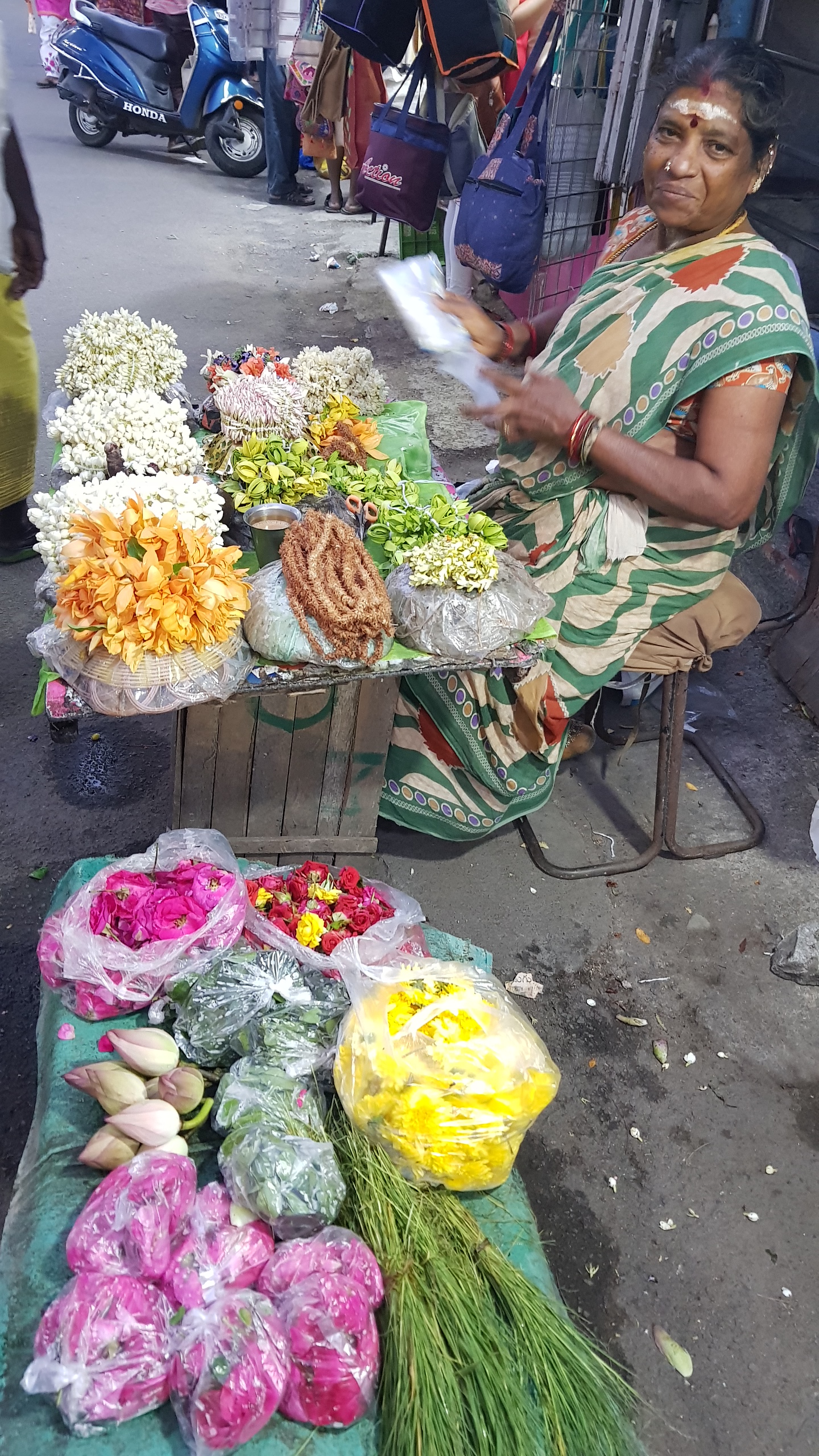
I was buying flowers from a street vendor in Mylapore. I got the three greatest and sweet smelling flowers for my Puja (friday Diya puja) Marugozhundhu, Manoranjitham and Shenbhagam that form the base for many perfumes. Today the woman who sold the flowers said she knew me. I was surprised. She asked me whether I lived in Adam street, Mylapore. I said I could be familiar because I frequented Mylapore my birth place and mother’s home. Of course I grew up in Mylapore.

Then the woman conclusively told me, ‘your paalkaara aayaah was my aayaah. for years she worked for your family. you were young. i used to come to your house with her. you are two sisters. you lost your mother early.’ The woman also called me by name and mentioned our family name – how we are referred to in our community. I was stunned. Then the face slowly became familiar to me. Not familiar actually. I could make a quaint or faint connection that’s all. I remembered the very old lady who fetched milk for us every morning. She had a hunched back. I was too young but her daughter Sokkamma with a polio leg was our housemaid before Kanniamma joined us. Sokkamma was the flower woman’s aunt. I went to Sokkamma’s marriage also somewhere near Tambaram with my parents. My parents got two of our housemaids married. The flower woman said her name was Mahalakshmi. She told me my grandma gave Sokkamma a gold chain for her marriage. Sokkamma’s husband was an alcoholic. She died soon leaving behind a daughter. That daughter Thilaka is now married and well settled. My mother and my grandma used to feel bad for her fate. They were only our house servants but my family deeply cared for them. Mahalakshmi said, that gold chain was with their family for a long time and it helped Sokkamma’s daughter when getting married. I was stunned by the flower seller’s memory. I was also moved to hear about my mother’s and my grandmother’s kind gesture. After Sokkamma, a girl called Kanniamma worked for us. My mother got her married too. In fact she named her daughter, the eldest born, after my mother.

My mother taught hearing and speech impaired middle school girls until the last day of her life. She had a kind of empathy for the lesser fortunate which was unheard of in those days. She was neutral and unbiased. She was far ahead of her times in many ways.

Today is my mother’s 40th death anniversary as per English calendar. I recall this only now and somehow forgot to get it when I was with the flower woman. My mother reaches to me directly. Nobody will believe if I say this. My Mother Goddess reaches to me in a way too that I cannot describe.

Now the time is 11 pm. My mother passed away around 10.30 on July 14, 1982. I observed the thidhi as per Hindu/Thamizh calendar. My sister observed it as per English date today.

Why should of all the days, months and years, I have to meet someone from my past who recalled my mother and grandmother today of all days. Exact day. I have been buying flowers in Mylapore for years and years. Not once have I met this woman before. Never have our paths crossed in 45 plus years. Mahalakshmi said she is 59. Look at her flowers. Her recalling of my name is unbelievable.

An Ambal upasakar told me that my mother did not have rebirth. Today’s incidence is surprisingly having a calming effect on me. Nowadays vibes are getting replaced with a peace in my case. For years I have received strong vibes in waves. Of late as I get older, I have an understanding in my heart that’s all.

This is the second time in a matter of three months, my mother has reached out to me. I don’t even know her really. I am learning more of her through third parties.

My mother was a flower girl who filled our terrace with potted plants such as roses, jasmine, hibiscus. december, kanakambaram, saamandhi etc., that we had no space to walk. Very interested in gardening, she would frequent the Horticulture society that was in Gemini, where she would board her bus back from school. We also bought so much of flowers everyday from street vendors. Roses especially. In the house that my parents built (which is perpetually leased out), my mother planted seven Ceylon (red) coconut trees, mango tree, curry leaf tree etc., and roses and hibiscuses.

My mother helped at least two poorest girls get married when they had nothing. In return Karma saw to that we two daughters married well in her absence.

Years after someone is gone, this is what stays behind. Our good Karma. Thank you so much for reaching out to me Amma. You just told me you are there always for us.

Posted in Political

Sri Lanka: A Replay Of Ramayana?

The videos of ruling party members’ homes and sedans going up in flames and the masses indulging in vandalism and looting in the Rajapakse palace taking to the swimming pool in a finishing touch, are very disturbing. Contrary to feeling victorious, me a Tamil who is supposed to rejoice at these happenings, find myself immensely pained by the developments in Sri Lanka. Vengeance is best served cold, they say. The island nation at the foot of the Indian peninsula met up with its Karma finally but that hardly makes us Indians happy. The unruly mobs and the shattered economy and the breaking up of law and order are a grim reminder as to how easily we as society can degenerate into uncivilized uncouth brutes wrecking havoc in course of destruction. I am someone who never appreciated reading from ‘Sundara Kanda’ of Ramayana, about Hanuman destroying even the Ashoka Vana or the ‘vanara’ (apes) uprooting trees in Kishkintha in celebration of victory. And Sri Lanka is so closely related to us not merely geographically but also culturally. What a replay of scenes from the very Ramayana! It is like the monkey kingdom having a free run with the wily king ousted. The Rajapakses may seek asylum in India but that is the last controversy India may seek. The common man in Lanka is suffering without food, medicine, school and transport. In short, Sri Lanka has just collapsed at every front: economically, militarily and politically. He/she need not have to a Tamil. Whether Tamils or Sinhalese, they are all Lankans. This is the worst time in history for both of the ethnic races. Sri Lanka did not suffer such a cruel fate even when there reigned Tamil militancy. The current crisis is not wrought in by the Tamils. It might not be easy to cleave out of the mess they are in today, and I am no political pundit to predict how this can ever be done either. China of course is the one prime reason or the only reason Sri Lanka is finding itself in dire straits today. Add up corruption and you get the picture. And these are Buddhists and Buddhists are known for their principle of renouncing worldly interests. With Sri Lanka and Burma, we have the rare scenario of the Buddhist governments growing greedy and bringing tragedy to their own people. The complexities that we now find in Sri Lanka can make for a good case study and should serve as a warning for other nations stretching it too far. Even for India, this is like an alarm bell to keep things rolling. Keeping my fingers crossed and watching out for Sri Lanka. Haven’t been there strangely but we do have a connection with Lanka.

********************************

There is a legend about the Sri Ranganatha temple gopuram (tower) in Sri Rangam and Sri Lanka. For centuries the gopuram remained unbuilt because it was believed that Lord Vishnu in his sayana (lying) position was looking at Sri Lanka straight. If the gopuram would be built, then His protective vision will be blocked and Sri Lanka will burn (because of curse heaped on Ravana). But ex Tamil Nadu chief minister M G Ramachandran (MGR) completed the tower and got it inaugurated by the then prime minister Indira Gandhi. Within an year, MGR, Gandhi and the Sri Rangam (mutt) jeeyar all were no more. There was never long last peace in Sri Lanka after that. Successful Sri Lankan governments have been carrying out many ‘shanthi’ pujas to appease the Hindu gods because the islanders believe in the Hindu legend as they are part of our cultural history.

Posted in Political

A Hindu Rashtra Where Every Citizen Is Equal

World can do with a single Hindu nation, no doubt. After all there are dozens of Islamic and Christian nations and even a Jewish one. There are Buddhist countries. It is of course sad that Nepal which was the only Hindu realm in the world has gone communist. India, where the world’s most ancient faith – the one and only unorganized religion the universe has ever had – has every right to proclaim Herself a Hindu Rashtra. India is the cradle of human civilization. Hindu dharma was born here and began flourishing right in our soil. Hindus are not warriors by race and have no significant history of invading others or enforcing their culture by sword as it has happened with the Abrahamic fold. India will be doing the world a favour by promoting soft power that is Hindu philosophy. We are not seeking a Hindu nation in Africa or America or Australia or Arabia or Europe. We are seeking a Hindu nation right here in India that we did not even seek during 1947 partition.

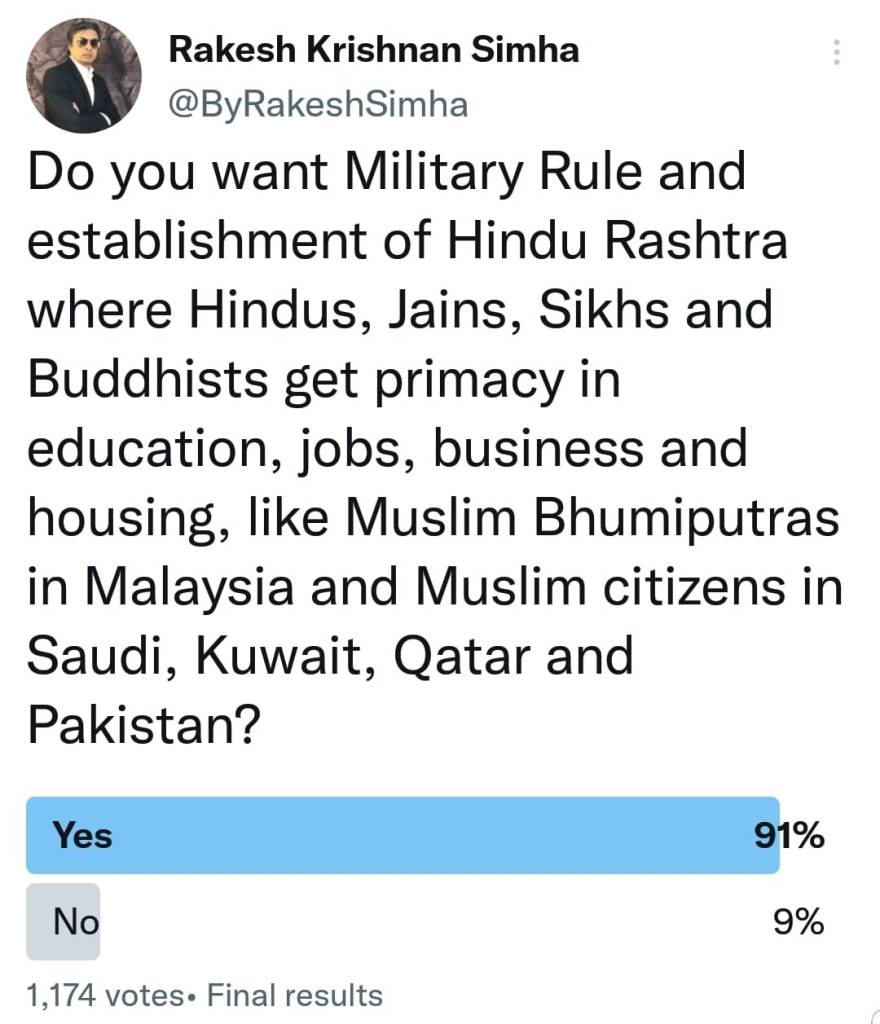
With strict enforcement of certain fundamentals of course, India can be Hindu desh by constitution. NO SPECIAL RIGHTS OR PRIVILEGES TO HINDUS ON BASIS OF BIRTH OR CONVERSION. EVERY INDIAN CITIZEN MUST BE ON EQUAL FOOTING BE HIM/HER A HINDU OR CHRISTIAN OR SIKH OR MUSLIM. The soul of India is eternally Hindu, no doubt about that. Even so, there are some disturbing posts in social media such as this one:

However I wouldn’t go by the vote count. After all, this is just limited to the world of Twitterati. Like exit polls that hardly predict exact election results, this post can be nothing more than the standard deviation, the variation we inevitably sample from a whole lot. Hopefully. This is a dangerous trend. It makes me wonder whether even aspiring for a Hindu rashtra is dangerous business. I guess it is unfair to expect India to stay neutral and secular when our minorities will stay opposed to family planning citing religious reasons, will refuse to come under the umbrella of one single common statute for all Indians irrespective of faith, etc. So when you expect to be governed as per your faith, it gives rest of Indians a sense of insecurity. Widespread missionary activity sponsored by foreign church and propagated by local evangelists is another reason why Hindus want to go for a constitutionally Hindu nation. In which case I would still want every Indian citizen to enjoy equal fundamental rights.

FREEWILL CANNOT BE THE PREROGATIVE OF ONLY THE SECULAR AND DEMOCRATIC STATES. FREEWILL MUST PREVAIL UNIVERSAL INCLUDING AND ESPECIALLY IN THE ISLAMIC BLOCK WHERE CONVERSION MAFIA MUST BE GRANTED A LICENCE TO PREACH AND PROPAGATE OTHERS WAYS OF LIFE. UNLESS AND UNTIL THAT CAN HAPPEN, THERE IS NO POINT IN SERMONIZING ON EQUALITY AND UNIVERSAL BROTHERHOOD. India and America and Europe allow and practise such a freewill. When reciprocation is denied, expect the curtailment of freewill in some pockets. Why cannot there be a Hindu banking in Pakistan or Saudi for instance if we have to have Islamic banking in India.

As a Hindu nation,

  • India can deem christian conversion mafia illegal and punishable by law.
  • Enforce strict family planning for muslims
  • Maintain Hindu majority 80: 20 versus others/non-Hindus. India’s democracy is dependent on India’s demography. Now that is the golden rule.
  • Remove the word ‘secular’ from our constitution in the first place. It was after all inserted by ex PM Indira Gandhi in 1976
  • Stringent action against any Hindu who may provoke/assault non Hindus safeguarding minority rights and restoring in them a sense of security.
  • No special concession for Hindus. All citizens to enjoy equal fundamental rights.
  • Unfavourable support to Hindus will prove to be counter productive. It will dilute our quality and promote mediocrity and substandard. If Hindus have to survive, we have to cultivate a competitive spirit. The moment you eye concessions, your edge is gone. Meritorious must win. Even in our neighbouring country sometimes they let the best brains to prevail irrespective of their religious orientation.

Some of us have our children living in foreign countries. I wouldn’t rule a backlash!

Secular democracies are like joint bank accounts from who anyone and everyone can draw out indiscriminately. India is a classic case. But Islamic nations are private accounts and fixed deposits that none can touch. Tell me then why we must have joint accounts in that case. Why can’t the Hindu account become a fixed deposit, recurring deposit, private account locked for years, with zero withdrawal option! Just a thought to illustrate, what is expected unfairly of secular nations like India.

India can continue to remain a secular democracy when all Islamic nations in the world also constitutionally become secular democracies with their royalties suspended. Now that is fair game.

Posted in Women & Family

Angaheenam.

About to extract a couple of teeth and get a bridge. I left an infection unattended as we had back to back lockdowns on pandemic for which I am paying a heavy price today. But its okay. There is a remedy at least. Even so, I couldn’t stop obsessing about my front tooth – yah sadly its right in the lower front of all places 😦 – that i have had since teething. Just losing my healthy teeth for no reason made me conscious of it for the very first time. Last couple of days I am going to the mirror and checking and checking my teeth and I find them strong ironically. Case of building strong, basement weak 😀 Then I pushed the thoughts of self pity out of my mind as I remembered the breast cancer patients who get their breasts hawed in pretty younger age. My beautiful willowy working aunt wasn’t even my age when she had her right one chopped. She was more upset about baring her chest to a male surgeon, coming from a very conservative family. The mastectomy was only her second concern. Once she understood it would be a life saver for her, she went under the knife wholeheartedly. She in fact has had a double mastectomy and double knee replacement. But she has a tremendous willpower. After her first mastectomy, she was on leave for a month that happened to coincide with her summer vacation. From the second month she would take a bus to her chemotherapy and radiation sessions and head straight to her school where she was teaching board X girls! Twenty five years later, the cancer has relapsed for a second time and has caught her in the esophagus. A double time covid survivor as well, my aunt just completed a course of forty radiations in the wrong side of her seventies. When I went to her straight from airport this May, she was the one who made the filter coffee for me. Her spirit is my greatest inspiration. Her first surgery was a neat job. Her second was hastily done up. It was then she cried, and never for anything before. She said, the surgeon botched up with his sewing because probably he did not even consider her a woman. She was just a blob of flesh for him to chop and stitch up. There was such a lack of aesthetics that my aunt for the first time in her life, felt like a freak She felt as if she was denied her rightful dignity. I could see the difference between both sides of sutures. The second one was a patch work done poorly. It revealed the heart of a very cold man. Every one has a soul including women with breast cancer in their sixties and seventies. Surgery may be basically butchery, yet we women are not the cattle to go under the blade. I do now get it how my aunt must have felt all those years back, having to forego her breast. But she would dismiss my concerns and tell me that she wanted to live long for the sake of her children. And if her breasts would come in her way, she would rather have them chopped without regrets. I do get the import of her words of conviction. What is that with losing a couple of frontals. Its okay. I have to have many loud laughs with my granddaughter. I have to guffaw at the jokes cracked by my family. Yet this word ‘anga heenam’ keeps haunting me as I run to the mirror to check my front tooth for the nth time. Something that’s been with me for 50+ years will be history. My heart goes out to women who throw out their breasts and wombs so that they can live for their families. The presence counts. The presence is what matters. The husbands who love their wives with their chopped breasts, with one breast with the pair gone – these great men merit a standing ovation. Anga heenam – losing a body part, an internal or external organ, can take a big emotional toll on women.

A friend who was mother of my son’s school friend, died of breast cancer. She opted out of mastectomy by will and settled for chemotherapy and radiation so that she would not be disfigured. But the relapse happened too quick. And she regretted to me having to pay with her life for putting vanity first over health security. A small tooth extraction can give us so much gyaan!!! Even the menopause is not easy on us women. Something with us for over 40 years just ceases one fine day. We know it is a biological cycle and it has to happen at the right time for our own sake. The hot flushes, the mood swings omg… I wonder why god made us women into complicated creatures. As my friend says, even the responsibility for anything lies with women as our reproductive organs lie within whereas for men it is external.

Kudos to women in 50s, two of who I know being mothers of my son’s school mates, who had to get both their knees replaced too very early.

Strangely I remember this from my working days after years, years…

There was this secretary to chairman. I was at that time a new appointee, youngest in my workplace. Anyway someone had already whispered in my ears that the stunning lady in her forties was a breast cancer survivor. One day she came to say ‘hi’ to me as I was a fresher. Then suddenly she reddened and told me, ‘i may have removed my breast but my ovaries are intact.’ The woman had had breast cancer in her twenties. She was single. She was such a looker. I got bewildered by her outburst. I told a girl who had joined with me what the woman had told me. I think the young me had sparked an envy in her. I never told another soul about this again. For days what she said was ringing in my ears. I understood her aching even though I was unmarried then. My heart goes out to her even today.

I kind of was also thinking of men who bodyshame women when they have not-so-pretty and duskiest daughters, skinny wives. These have to be monsters to make a meal out of women’s souls. My take is that, insufficient men find an urge to belittle women who are too good for them.

The breast cancer women who removed their breasts were most beloved to their husbands, as I bear witness to their happiest fulfilled lives. The men did not seek pleasure out of turn. The anga heenam can be in our body, but not in our minds. That is the point.

Beauty lies in the eye of the beholder. We WILL always remain beautiful to the deserving ones in our lives, the worthiest of our love.

Posted in Political

Bhaga Pirivinai

There is an old Tamil picture by this name. Bhaga Pirivinai means partition (of inheritance) when siblings go their way breaking the joint family home. Its a heartbreaking thing in most Indian families.

I originally wanted to review the pic ‘Partition 1947.’ It is directed by Gurinder Chadda, whose grandparents lived the nightmare of partition. Inspired by Domini Lapierre’s ‘Freedom at midnight” this story has been retold a million times as we know. So much so that the partition saga to us now has gone stale. Oversold. The same trains set to fire. The mob violence. The bloodshed. The mass migrations. But what really moved me this time was, the dividing of spoons and ladles in the viceroy’s kitchen in Delhi. I almost felt a tear sting my eyes when that went on. Tuba for India, the French horn for Paksitan. That kind of sharing of cutleries and crystals. Tableware and napkins. And even the encyclopedia. I have always viewed the two countries as two different entities, having been born decades after partition. Being a south Indian, you cannot relate to the border ordeals at all. But in that one frame I saw the nations India and Pakistan as one family for the first time. It was heartbreaking. It is always. I have been in a joint family home before we built our own nest. Right now with the empty nest syndrome. I just know how it feels. It wasn’t easy leaving the joint family at all. Yet someday the inevitability has to happen.

Blessed to have family far from the borders. I would ask my grandma how the day of independence was. ‘It was a government holiday, public holiday’ she would tell me flatly! There was a single public radio broadcast in Luz central in Mylapore I believe where the famous Nehru speech that began with the booming words, ‘when the world is fast asleep India will wake upto…..’ blah blah blah, was played at midnight from the Red fort, Delhi. Crowds gathered to listen to it. My family owned a radio I guess so they listened to the speech at home. I don’t clearly remember. I wish I had paid more attention to my gran. She said, sweets were distributed after flag hoisting and singing of some national songs. Not sure if it was our national anthem either. Some patriotic songs sung by locals. After sweet distribution, everyone went home waving flags, she said. She always mentioned to me it was a govt holiday as my grandfather worked for government! Then next day he went to work hahaha! This was how August 15, 1947 unfolded in real life to my family. No partition ripple was ever felt. Thank god there were no social media or mass media and news did not travel miles in seconds. South remained peaceful for that reason. Everybody simply went about their business. My grandpa was a commerce graduate who rode a scooter and who smoked and who loved to dress up in sherwani like a north Indian. He was a looker! Just another day in our family I guess. Only the war times were a bit tense I believe, especially the 1971 one. Even then there were only radio news bulletins nothing more. But nobody liked Jinnah. Yet my people always felt the partition was a blessing in disguise. We always want to remain a Hindu majorioty country and would not want to be defeated by a population jehad. Hindu families have shrunk in size.

I may be secular, democratic with an open mind, yet I know India has a chance only if we are 80-% Hindu majority. Our democracy lies in our demography. I would blame Mountbatten for his hasty plans and exit but I guess he cannot be held totally responsible for whatever happened.

Anyway, present generation couldn’t care less. Our this India of ISRO and Infosys and world CEOs are a making well after 1947. No Mogul can take the credit. Not even the British. I love India the way she is. As headstrong as me hahaha! Proud and defiant!

I don’t regret partition. It is the best thing to have happened to India. This culmination into partition that came after centuries of brutal invasions is a natural progression.

Yet the Bhaga Pirivinai is never easy. It leaves a bitter aftertaste. Years later when you revisit, you still feel the ache and longing in your bones. That is family. The partition trauma will stay with those in the border states.

Btw I had a terrific maternal grandma. Probably she ignited the political interest in me in a young age. Fifth class dropout who could read and write Tamil and English fluently. I remember her reading the book on Kennedy’s assassination. My mother and she were discussing the report. Now in this 2022 I can see what a phenomenal grandma I had. I will prove to be one too to my darling cherrie granddaughter!

******************************

PS: Celebrating the good old days in my pink legging today, made in Pakistan 😀

Posted in Political

Agnipath: the path of fire.

Agnipath does give me the jitters. Someone has put in exactly what was going through my mind. Unnecessary militarization of our young men and women. Dilution of military standards. On the other hand effective engagement of an otherwise idling youth population. Inspiring career option. This can change the way the Indian youngsters may be viewing India. There are other pluses: fitter and younger men and women for our armed forces. No industrialist who talks big about employment of the discharged military men has ever absorbed any ex-servicemen in their production line as history reveals. Unemployed (war) veterans are a baggage. Can we rule out in entirety a trigger happy 22 year old youth community from wrecking havoc when frustration mounds. Agnipath is a double-edged sword to be handled carefully. What would the young men and women who retire on four year commission do with a bounty of eleven lakh rupees each. Their mental maturity may not match their physical prowess. At 22, the boys and girls are still kids. They are to miss the vital years at university for which the military school training with honours degree can hardly be a substitute. They will be missing the fun and action and may not fit back in easily. A fourth of the Agnipath’s Agniveers may successfully get enrolled in our armed services and go on to make a career as army, navy or airforce men. It is the other three fourths of who we could be clueless. Agnipath may be a temporary solution to deal with the rising unemployment issue in the country. The world will get increasingly high-tech and automated, with machines taking over most of the jobs meant for execution by our labour forces. A very small percentage of human population will be the actual workforce in years to roll. One has to resign to such an inevitable fate not in very distant future. In a way perhaps, Agnipath can be a lifesaver but no way a permanent answer. Agnipath mandates clearing of basic and minimum criteria tests for recruitment. Agnipath may be ‘dream come true’ for millions in this country who aspired to get into military services but could not owing to stringent standards in commissioning. Our political thinktank must know, Agnipath will not pan out like the Demonetization or GST. This is an entirely different ball game with the nation’s security and interests at stake. For the moment I keep my fingers crossed. I am not happy or cheerful about Agnipath. To me Agnipath is a gamble that can go either way. Even if it can take off with a zing at the outset, one cannot rule out when the agnipath would boomerang right into our backyards. A lot of my countrymen may cite Singapore etc., where enrollment in military services is mandatory for their citizens for upto four or five years. The sooner it is done, the better. But India is not a dot on the world map like Singapore is. India is gargantuan. My only hope and relief may be that, we are simply too big for a coup to overthrow our government or hold our capital hostage!

Posted in Books

Review: Points of Entry – Nadeem Farooq Paracha.

Well, I am just done with this one, I took all the time I could to read it because I live with my books for days. If I finish a book too fast, I forget it fast. To let a book seep deep into my psyche I read it ever slow. That way I retain its pages and memories for days and months to come. Over time you forget details, but slow-reading helps keep what you read fresher in mind and for longer.

This is my second book by the author. Frankly the first one to me sounded amateurish. Understandable, as the author was stepping onto new tarmac, writing books. But I have been reading the columns by the author for long, may be some 10-12 years now, that I have developed or acquired a taste for this style of writing. What made me come back for more in those days was the political satire and trademark sarcasm. I never expected such a firebrand from our neighbours who I always imagined to be dour and boring lacking inspiration and mirth!!!

So from journalism to authoring on research is a natural progression I guess. I think in my mind, I gave nicknames to the author in his prime blogging days: postmortem specialist (!) (for the way he analyzed matters throwing everything threadbare especially about Cricket). His blogs were winding!

But I would like to now commend the author for keeping the book short and sweet. Just the right volume, crisp writing and good finishes. Nice correlation to the subject or theme of the book. Different approach.

The language is an awow! I love the prose, the flow, the grammar, the idioms and phrases, the metaphors, the simile or whatever! In fact I try to copy from the author (i am amateur and very private blogger)! In my early blogging days, the author was my psychological guru (of which he may have had no idea)! Anyway, who am I here to review any book. Just a housewife me past my prime with too much time in hands. But books take my mind off a lot of matters and give me a strange sense of peace. And this is one of a kind.

As for the book, I guess the author has come of age. May be this is his third? So what did I miss. I read the first in my kindle. This one I got as hardcover edition in India.

Normally I don’t subscribe to Pakistani views (!) in many matters because, there is this conflict of interest in anything of India-Pakistan nature. But the author is neutral kind of. Rational. This I have inferred over years reading him. I think I can go with him.

I like the lucid prose as I said. I like the precise narration interspersed with personal touches here and there to the right measure to add spice and credence to the story. Here is one window into contemporary Pakistan history and culture on broader spectrum. May be a bit unofficial, if I must add. The author could have drafted the volume in more official form editing parts, had he wished to make it a text book for young Pakistanis in near or far future. How about building this aspect into future works? This can do for a nice non-detailed read for English literature (and not history) for standard 11 & 12 in my opinion. Or even class 9 and 10. I mean, by Indian standards. I would want the drug details to be edited. And I would ask for more specifics.

My particular love is Indus Raga. Indus raga is the raag called Sindhu Bhairavi literally in classical Hindustani/Carnatic, the native or traditional music of India. It is also a raag very close to my heart. I liked the sync the author made with the chapter and the raga that took the name of the magnificent Sindhu nadhi, albeit unwittingly. Anyway loved the sindhu folk music and thanks a ton for the reproduction of the verses. Of particular interest was also the entry from the west on Pakistan pop and sufi pop in specific. This one authentic Pakistan music/art form has millions of followers from India and I am one among them even if I am not as knowledgeable. If I can have a say on this matter, I would like Pakistanis to master the Hindustani classical. The old doyens must have done that, but the current crop may not be keeping up with the classical. You will lose the sound base when you don’t take care of the foundations, in my opinion. Western music is totally a different scene. And dear author, don’t call it eastern music please. Have a heart and courage and intellectual honesty to call Hindustani classical by its name. You have every right to stake a claim in undivided India’s Hindu cultural past. You cannot write Pakistan history without mentioning India. You are Pakistan only from 1947. For 4000 years you were India and for 3000 years or even 3800 years you were Hindu. You are muslim and Pakistani only for a decimal fraction of Hindu Indian history. Of course, this is the point the author has been trying to score in his entire book. And unlike southern India, what constitutes Pakistan was prone to multiple foreign invasions. Has it ever struck any Pakistani that, had the British been like the mugals spreading faith by sword, they would all be christians today?! You can ask the Filipinos. They were muslims first, but with Spanish conquest, they converted from Islam to Christianity. 200 years or so of being muslim and then becoming fanatical christians. Yes, this is also history. This is the history of the vanquished. Now there are no pious catholics like our filipino brothers and sisters. Soon they will grace the world with a pope!

My favourite Pakistan pop was Junoon that I was crazy about in my Malaysian days. Not a day went without listening to them. I love the deepthroated base voice of the Pakistani male vocalists.

I wish I can visit Mohenjo Daro someday. Otherwise I have to satisfy myself only with the Bollywood flick with our desi Hrithik Roshan hahaha! King Porus was actually the Hindu king Purushotham who Alexander defeated. A word here. I had this ‘de javu’ reading the book as the content sounded familiar to me from the author’s columns in their national newspaper.

The book is an insider view of Pakistan in 1980s. My first memory of Pakistan was about Bhutto hanging. It was in the Tamil daily ‘Dhina Thanthi’ and even ‘the Hindu’ I guess, that my granny read aloud. That was the first time I heard the name or word called Pakistan. I don’t remember the year. I remember my parents discuss this though I cannot recall the finer details. I do recall the fireworks going up in my neighbourhood when the Zia plane crash news was out. I too jumped up and down with friends in celebration! I think we friends assembled in our terrace celebrating the demise of the monster. The last moving news was Benazzir’s assassination which felt as worse as Rajiv’s. I am not lying when I say whole of India wept for her. We did mourn her in our holiday resort for the year end. It spoilt our picnic mood. It was a moment to reckon for me and most of us in India the way the shock permeated us. At that time, we felt a connection. But why should that happen with a tragedy of such mammoth proportions. Why can’t we just be friends.

To my knowledge, Indians in general see Pakistanis like siblings in spite of cultural differences. India is naturally protective about the entire Indian subcontinent and we may feel responsible for the SAARC nations. You will understand this only when you are Indian by birth. For us the other five to six nations carved out of one landmass Bharat Varsha – Nepal, Bhutan, Pakistan, Bangladesh, Sri Lanka will always stay Bharat or extension of Bharat. But gladly there is no India anti-thesis in this book. I am weary of Pakistani writing for this one thing. They all implicate India in some manner for something. It was a relief reading the book with no reference to India mostly. Not even the Nazia-Zoheb connection to India through Qurbani made it to the book. That is very thoughtful on part of the author. Nazia Hassan was my mother’s favourite before she passed away in 1982. I could sing Nazia’s and Runa Leila’s in that year in the generally non-Hindi speaking Tamil Nadu procuring cassettes. This demonstrates the reach of Pakistan pop in India.

What is my general take on reading the book and on Pakistan: you need to work a lot more hahaha! I do sometimes find the flair missing, please don’t get me wrong; I mean, the flair is missing about the nation. I find this in amateur video edits, news bulletins, etc., where I find the finishing not upto the mark. I find the professionalism lacking. I find the same issue with Pakistan produce that I come across in middle east. The packaging and even the substance leave a lot to be desired. I can’t pinpoint reasons. May be there aren’t many motivational heroes. Inspiring personalities. See, it is not about the size or ethnicity of a nation. You must have that spark. If you don’t have it, light one up.

I may not have traveled as widely as the author but I am also an NRI (non resident Indian) on and off for over a quarter century. We meet Pakistanis in our everyday life in the middle-east. Our men work together in the same professions. Generally we are polite and civil towards each other. North Indians especially enjoy such a bonhomie with Pakistanis as they speak the same language and even share similar cuisine. Every time I pick a Pakistani produce such as fresh green peas or green tea or a kurti, I think of the Pakistani farmers and not of Musharraf or Kashmir or the nuclear missiles or even Modi! I see Pakistanis buy lots of Indian stuff. There is presence of Indian manufacture and even Indian automobiles in middle east, but never have I come across a made-in-Pakistan industrial product. Brand building is not an easy exercise. India did not have it cheap or easy.

Traveling does open avenues of your mind. But the essence of you always stays with you wherever you may go. I agree with the author that their economy is in doldrums, far worse than Indian. I have heard of widespread corruption putting even India to shame! But the pot cannot call the kettle black. So I stop here!

The book is a breezy read – like even a coffee table book. Refreshing perspectives. Is it too much to have expected pictures?

Its okay, enjoy being called an Indian, buddy! I am happy you are mistaken for one! You are after all Nadeem = mitr = mitwa = dost = snehidhan(e) !

Posted in History-Culture

The Unsummable.

A  μΣ called I N D I A hahaha 😀

The unsummable, undefinable, unbelievable, immeasurable, uncontainable, unfathomable is my India. This is what courses through my mind whenever I read summation or brief historic stories that tend to capture everything of a particular place at any singular point or period of time. To be fair to the authors of these news capsules, it is possible that some places, some communities, some epochs of history can neatly fit into boxes of definition, time period, region, faith, nationality etc., that it is so convenient to just pick up the appropriate pieces and assign them into the relevant container and label them and total them enmasse, in quantum. This can give you a general idea of things. You get the picture. Can this ever be possible for or with India? Did our history begin by 1947 or have we had one for over 4000 years now. Do we have to have our gods come down to us from the Middle east or do we invent our own. How many architectural marvels will you write about? One chapter each for the thousands of 1500-2000 or even 3000 year old vast ancient temples dotting Tamil Nadu alone that have withstood not only the environmental erosion but also destructive invasions by foreign army. I just visited an acre huge and over 1500 year ancient one raised by the Chola king in the temple town of Chidambaram, 250 km from Chennai. The dancing Shiva’s foot has this big toe that rightly points to center of gravity.

Here is a quick copy-paste job: research of our ancient temples is ongoing spanning decades now.

Western scientists have proved that at Lord Nataraja ‘s big toe is the Centre Point of World ‘s Magnetic Equator.
Our ancient Tamil Scholar Thirumoolar has proved this Five thousand
 years ago! His treatise THIRUMANDIRAM is a wonderful Scientific guide for the whole world.

Its called the center of earth,because earth is the only planet to have both magnetic and gravity field. So chidambaram is the place for the starting point or middle point of earth gravity, satellite above chidabaram Temple doesn’t work due to the action of magnetic field on this place.

(Satellites don’t work when they are right over the Chidambaram temple that led to research).

Well, this is just a sample. One of the million amazements.

How many music genres to encapsulate: from classical and instrumental to commercial filmy and folk. Dance forms. How many points of entry for Chennai alone. We have an Armenian street that had the Armenians living here when on business for centuries who built the cathedral that stands until today. We have the borah muslims and sindhis. I once even met a woman who said she had pashtun origins. Her family moved down south during partition. The ocean called literature and language: my native Thamizh will give any world language a run for what it is worth. Thamizh is the oldest spoken language in the world, older than Latin and may be even Sanskrit who knows, that is now bestowed with the classical status. Having a structured grammar in Tamil in 3 century BCE, in a full court where women poets compose and sing in the king’s presence… and the dam across the river Cauvery the king raised standing tall until today with light touch up here and there… having a maritime past in ancient Indian history…. we were n’t the conquered but we conquered the south east Asia including Malaysia, Ceylon, Burma, Indonesia… Does this ever figure even in Indian history text books? The fine arts of jewelry, dyeing of fabrics and weaving: weaving tradition of India alone is an inexhaustible subject. Thousands and thousands literally of the intricate weaves and handblock prints. Imagine the national, state, district, village diversities. India’s cuisine is the best window to the enigma called India. There is nothing to match it in the entire world and there can be no justice done scooping it all at one go for connoisseurs’ delight. What about our geography. Against the imposing icy peaks are the parched deserts and the tropical western ghats lush and rich after the fertile Gangetic plains. There are the frothing snaking rivers and the forest reserves and a wildlife scene next only to Africa. We feed the world while we feed a billion of ourselves with our wheat and other farm produce. There is no way one can summarize even such things as IRCTC, our railway that ferries not only millions of passengers any day across destinations around the country, but also carry goods to the tune of tonnes and tonnes. The largest network after the Amtrak perhaps. The armed forces. The banking institutions and the IT sector. The pharma and the medical advancement.

Sometimes, I do wish India is less chaotic, better manageable. Even the US is readable! We can have gross estimates about everything there as the history is very new or almost absent. For a continent as huge as America, that really comes as a surprise. When we resided in Malaysia, sometimes we would drive through 3 or 4 or even 5 states in a day, something unthinkable in India. It is there some 25 years back I understood what it is to be the giant landmass called India. I got a cognizance of her sheer size and beauty and also her ethnic diversity and varied nature that I could never get a Malaysian understand what India is like. Because we are not the uniform like aisles and aisles you walk through in a shopping mall: standard and neat and nicely labeled. We are the complex sigma. We just cannot be computed. We are truly into the infinity! Where do we begin and where do we end. At the time of the moguls we also had concurrent history in rest of the peninsula that is a different face of the multi-faceted prism called India. Hinduism also grew in leaps and bounds right under the invasion times because, it is in 7th-8th century CE that Shankara Mutts were established right across India – including the one in Kashmir. Hindu Dharma entered a greatly civilized phase around this time dropping warfare and embracing higher spirituality. I would call this period a Hindu reawakening time. So many many things unfolded in India at this point of time, and the mugals were just under a ten percent. To those from tinier nations with inconsequential population who hardly impact the world matters (who i have met in the gulf countries), I do not even try to explain India, because they can’t and they never will get the full import. Neither can I do the justice because I am not primed for it, for I lack the knowledge and relevant expertise. Also it is not my job. I let them be. I just know I am from this phenomenal place like which there is no other place on earth. India may have gone to the dogs lately but it is still that magic that can intoxicate you totally. Coming from this mammoth democracy gives me a natural confidence. I know this also means a tremendous responsibility: not only for those of us who call India our home, but also for our policy makers in economic, political, scientific, technical, agricultural, cultural and even medical matters. One inevitably sinking truth is that, yes India hugely impacts the world. And I am not talking of mere Yoga our soft power, or the meditation or Ayurveda. I am talking of how our actions may lead to chain reactions, create demands for instance in global markets kickstarting unending production cycles contributing to changes in environment. India to me is ONE HUGE REPONSIBILITY. What we consume, what we research, what we produce, what we share – all this can affect the rest of the world. I guess this is the only summation I can come up with, for my India. INDIA IS ON THE MOVE. Nothing else about my elephantine country is definable. We aren’t a measurable quantum. You cannot size us up and write a theory. We all do our little bit here and there and try to sew up this magnificent carpet called India.

Posted in Economic

Title Deeds In Bold Fonts

NRIs who own estates/homes in foreign countries may know what it is to hold crisp, concise documentation for your investments. No encumbrance ever. Clear title deeds. Neat presentation. Slim portfolio. Sits snug in your briefcase. I did expect this to be the case of papers filed for properties bought and sold in the US, Canada, Australia and Europe. In the case of Asia, I expected such a neat work from the Asian tigers and Korea and Japan. But I happened to chance upon a title deed held by a Filipino in Middle east sometime, that was so concise, fitting perfectly in an elegant file folder. It was easy to handle and refer to. It didn’t seem to run to hundreds of pages. Computer fonts advertised that every single detail held electronic data proof. Ever since I have been wondering, where in India we went wrong. Like in India the filipinos do have language issues with a hundred dialects spoken from island to island in their scattered archipelago nation. But their government seems to have unanimously chosen the English language for official communication. When I looked at their impeccable presentation, I was reminded of the pages and pages of soiled title deeds punctured with staples and holed for tying with thick legal ropes, covered with smudged seals from indelible rubber stamps with no space to spare. Indian title deeds to properties are a riot of colours. Hardly there remains a margin for any notation or observation or comment. We register deeds invariably in local (state) languages and rarely is a documentation done in universally understood English. Which means, the mother or parent documents in a title deed may make no sense to someone from Delhi buying a flat in Chennai for instance. Stamp papers are the way we Indians pay court fees for registration of properties. The top one fourth of every document sheet is therefore reserved for the stamp value affixation. Small mercies: we switched over to A4 size finally with the turn of the century. You just can’t fit the old sepia-tinted papers of another age and time, neatly into a present day folder designed for the A4 culture. To me the documentation in foreign countries underscored the discipline that you found in these places that is lacking in India. Just like us Indians, our title deeds are chaotic and messy making no sense to third parties. There may not be relevance, but documents must be legible and comprehensible to whoever. I guess the title deeds you may find in other parts of the world may be decipherable to a great degree unlike our complicated Indian title deeds that come as a loose bunch mostly: of tattered papers with ends frayed and haphazardly tied up, ink or print blotched. Things are changing in India as well but India being India, do we even have an idea on ‘standardization’ ?! Years before, there was not even the need for the seller to present himself/herself to the registrar when someone sold/bought a property. We have come a long way since then. Now apart from solid admissible ID proof and third party witnesses, there are conscious efforts to adhere to legal parlance in entire documentation leaving no grounds for ambiguity. Loopholes are plugged in documentation process at every stage as much as possible. While bribes have not been completely abolished from registrar offices, there is the saving grace that the data are saved by the government and a lot of the registration process is well streamlined. The statistics garnered must help in future planning. Lot less hassles compared to what it used to be just a decade ago. So can we at all have a neat and presentable documentation of our title deeds?

There are a couple of interesting discrepancies or differences between how we Indians document and register our title deeds and how the rest of the world may be going about it.

Unlike some newborn nations, India has the longest history and living memory which adds to our backlog of attached documents. This is called the chain of title deeds that cannot be broken. We have reams of papers connecting the dots! Government mooted development projects or settlements are not as common in India as in the newly formed republics. In the latter’s case, there is very short history to be recorded formally which means least documentation.

Well for one thing, India seems to be one or one of the rarest nations on earth to have nonjudicial stamp papers for registration. Look at others. They are way too simple. That header is a huge space consumer for us. The stamp duty is calculated at about 7% of guided value of property in question approximately. Further registration charges apply. To that effect, the stamp papers are made in India wherein the title deed may be executed in front of the concerned registrar. This is the legacy from the British Raj understandably. But is it not time we do away with this cumbersome practice. Why cannot the stamp duties and registration charges levied be printed in the annexure to the documents. Or perhaps in the place of the wide header, a small and simple square stamp will do. When did world nations grow out of the stamp paper practice that India is still keeping up.

India has adopted a whole range of economic reforms in last few years. One more in the mode of documentation of our title deeds is the need of the hour. Sleek title deeds crystal clear and to the point can be possible. If I were the prime minister, I would constitute a legal panel to look into this matter. Simplification of procedures and uniformity of terms and conditions and styles of registration are a must. As nothing in India is standardized from our garment sizes to school bus colours, we are at a fix when it comes to grave issues like title deed uniformity and standardization. How would you go about the chain of links or the history of documentation.

The watermark authentication seal must be the only way a title deed can be verified. This will leave room for observations and foot notes if any, at the time of registration. The deeds in any case must not run over a couple of pages. We are not writing volumes here.

Postal addresses in India need to be contracted and regularized as having a distinguishable PINcode has hardly helped matters. Along with postcode, the residential/commercial addresses must not run over four lines. This is how addresses are printed in America.

Paying detailed attention to every entry in the title deed and rectifications and regularizations can make way for sleekest and slimmest document folders in future.

World is growing out of physical monetary system, physical ID proofs, physical certifications etc., and even physical board meetings, as we slowly transcend to the digital age. Soft copies cannot summarily replace hard copies and the original title deed documentation is one such an area where transit from physical form to digital can be slowest and unreliable. May be in future, there is the possibility when we can entirely shift to electronic documentation. One of the hurdles that prevents such a total transformation is the age old parent documents that have to exist to maintain the chain link and authenticity of title deeds. The clue lies in how we process these old papers and bring in a revolution in the documentation process. Is Pradhan Mantri ji listening. Have you given a thought to this ji. Further, will this be foolproof. Can the digital title deed lead to scams and forgeries. Or is this the way forward.

Just a thought. With this I set the ball rolling. Why not. When Aadhar is here, PAN is here, Rupay is here, PayTm is here, Smart family card is here, Smart driving licence is here, when futures trading can be done from the cool comforts of your home, when there is the cryptocurrency, why should not be there an electronic title deed at all. How do we assemble the jigsaw puzzle.

****************************

I am limiting the scope of this post to mere appearance and/or shape and physical volume of title deeds with no input for substance.

Posted in Political

India can do without those damaging loose cannon shots

When our Indian politicians and bureaucrats decide to shoot their big mouths off target, nobody can shut their nonsense and filth up. So damaging were the recent off-the-mark remarks that have sparked a fury in the Middle-east undermining India-GCC bonhomie that took years or perhaps decades to foster. So much so that our late external minister Smt. Sushma Swaraj could quote from Sanskrit at the OPEC meet where Pakistan was kept at bay. Foundation stone for Hindu temples in the Emirates were laid by ruling Arabs. Just imagine the clout India has been enjoying in the epicenter of Islamic fraternity. Millions of Indian citizens are gainfully employed in the gulf nations repatriating valuable foreign exchange over years. Indians own business enterprises, Indians run hospitals to supermarkets. Indians are successful entrepreneurs. Indians are doctors and engineers to shopkeepers and teachers. Indians are SAP professionals. Indians are bankers. Indian community is far better placed among the whole lot of expats – some 100+ nationalities, who constitute the workforce in various capacities in GCC countries. Indians enjoy unparalleled prestige and respect in the Arab world that took years and Himalayan efforts to earn. And a majority of Indians making a living in Islamic nations are HINDUS. India’s traumatic history has left some scars no doubt but we are now invested in mutually beneficial economic and productive activities in the Middle East, that has offset many a bad memory kept alive only thanks to our textbooks. In today’s context especially when world economy is sluggish and employers are cutting corners giving pink slip to long serving staff without batting their eyelids, GCC nations are doing a great job employing not just Indians but blue and white collar workers of every race, hue and faith without a discrimination.

We expat Indian Hindus feel safest and securest living in Arab countries over living in crime-ridden India. We are respected, treated fair and well provided with. We enjoy world class medical and other amenities for FREE. The Arab governments take good care of us. For most of us NRIs, it is the inevitability of returning to India for good someday that seems like a nightmare.

Exactly what is the contribution to Indian economy from the Silicon valley NRIs in the US. From the Patels of hotel chains. It is always the expats employed in Arab countries who fill India’s coffers with foreign currencies and gold bullion. It is the NRIs from middle east who drive the stock markets and real estates up with their substantial investments. Who is buying the gold bonds, debentures, retirement plans and insurances the way the expats from gulf nations do. Suppose the NRIs in the gulf nations are to be displaced, can India find suitable placement for every single one of them returning home. Its not just economics, employment in gulf also guarantees India longtime peace and spares India from civil-war like grave economic situations. The harsh truth is that, the core industry of India still cannot absorb the quantum of fresh graduates Indian universities are churning out year after year. Where will all these young men and women fit in. Partly Indian government’s headache finds a panacea in job markets open for Indian citizens in gulf countries. Unlike the US, UK, Australia and Canada who want only the creamiest Indians leading to braindrain in India, the gulf countries provide scope of better and fruitful engagement for our middle level grads and even factory and site workers. To absorb and train a healthy chunk of the core industry workers produced by India is the greatest service the GCC countries render to India. Once upon a time, it were the Keralites who comprised the maximum percentage of Indian expat community in the gulf countries. Now, there is representation from every corner of India in gulf nations. Representation found a new meaning, I mused, when I struck up a conversation with Bhutan women in a shopping mall in Qatar. There are the blue collar workers employed as site workers, chauffeurs, cooks, shop assistants, nursing staff etc., who may be otherwise jobless in India plunging the nation into misery and chaos.

Will Nupur Sharma or whichever loudmouth find jobs for millions of Indians gainfully employed in GCC countries, in India. What is the need to upset the applecart? Highly irresponsible. Years of diplomacy and political correctness and goodwill have finally come to a naught thanks to such an insensitive ignoramus. The cost of this hostility will be borne by the labour class and working class Indians working in GCC countries. Every single loose canon shot by careless Indian politicians damages the political goodwill hard-earned by the Indian diaspora over years. It only takes a moment of sheer callousness and thoughtlessness to destroy such a precious relationship that India has been traditionally enjoying with Arab countries. Our media guys are bastards. Jealous outright. They would rather see the NRIs suffer because these guys are now sweating it out in our tv studios. They will do anything to inflict damages. Then there are the TRP ratings for sensationalizing non-issues. India never took sides when the GCC countries were divided over Qatar. Top brass in India as well as GCC nations are aware of the significance of the strong ties enjoyed by both sides. It is time for Modi government to shut some loudmouths tight. India has been a great ally to Arab countries walking the tightrope, never missing a foot. Hopefully this matter dies quietly the soonest. India can do without these debilitating controversies. This is no good.

Is this a local Indian issue: May be. Media still has to play a responsible role. Sometimes the architects of riots are none but the Indian media. The ones who must be booked are the anchors who did the lead and the producers behind the stories.